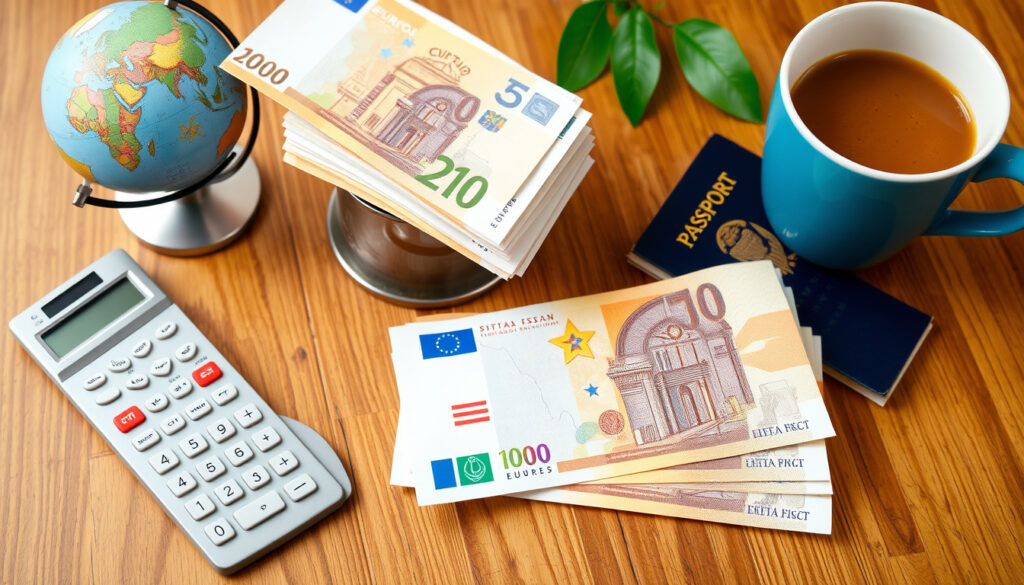
Vietnamese Dong to Euro: Conversion, Rates & Travel Tips
The mid-market rate makes converting Vietnamese dong to euros straightforward, but the rate you actually pay depends on fees and spreads. This guide covers the figures you need, common traps, and what your money buys in Vietnam.
Current mid-market rate (1 VND): €0.000033 ·
1 EUR to VND: ₫30,106 ·
ATMs in Vietnam: Widely available in cities and tourist areas ·
Cash declaration limit: Over $5,000 (or equivalent) must be declared ·
Typical daily budget in Vietnam: $20–$50 per day
Quick snapshot
- The Vietnamese đồng (VND) is the official currency with banknotes from 10,000 VND to 500,000 VND (Vietnam National Authority of Tourism)
- Mid-market rate as of latest update: 1 VND = 0.000033 EUR (XE.com)
- The actual exchange rate you get will include fees and spreads that are not shown in the mid-market rate (Wise)
- Rates at airport and hotel desks can vary significantly from the benchmark (Western Union)
- As of July 2026, 1 EUR traded near 30,108 VND (XO Tours)
- HSBC Vietnam listed buying rates around 29,486 VND per euro (July 2026) (HSBC Vietnam)
- Rates shift daily — always check before exchanging (XO Tours)
- Before your trip, compare rates from banks, licensed gold shops, and online platforms (Western Union)
- Once in Vietnam, ATMs are your best bet — choose VND at the machine (Wise)
Five key data points, one pattern: the mid-market rate is your benchmark, but the rate you actually pay depends on where and how you exchange.
| Metric | Value | Source |
|---|---|---|
| Current mid-market rate (1 VND) | €0.000033 | XE.com (mid-market rate provider) |
| 1 EUR in VND | ₫30,106 | |
| ATM withdrawal fee | Typically 22,000 VND + 1-2% foreign transaction fee | |
| Cash declaration limit | Over $5,000 or equivalent must be declared | Vietnam customs regulations |
| Average meal cost | 40,000–80,000 VND ($1.70–$3.40) | Vietnam National Authority of Tourism |
How much is 20,000 Vietnamese dong in euros?
What is the current exchange rate?
At the mid-market rate published by XE.com, one Vietnamese dong equals €0.000033. That means 20,000 VND converts to about €0.66. This is the rate you see on search engines, but it’s the wholesale interbank rate — you won’t get it at a counter.
How do I convert other amounts?
The Vietnam National Authority of Tourism suggests a simple trick: remove three zeros from the dong amount and divide by 30 to get a euro estimate (Vietnam National Authority of Tourism). For 20,000 VND: 20 ÷ 30 = 0.66 EUR. For 100,000 VND: 100 ÷ 30 = 3.33 EUR.
Why do rates vary?
Banks and exchange desks add a margin — the spread. HSBC Vietnam (major bank) in July 2026 showed buy rates of 29,486 VND per euro and sell rates of 30,689 VND per euro. That 4% gap is your cost of conversion.
The mid-market rate is like a menu price — what you actually pay includes service charges. Always ask for the “total cost in euros” before exchanging.
The implication: the rate you see online is a starting point, not a guarantee. Expect to lose 3-5% to spreads and fees.
Should I bring euros to Vietnam?
Can I use euros directly in Vietnam?
No. The Vietnamese dong is the only legal tender for everyday purchases, as confirmed by the Vietnam National Authority of Tourism (official tourism body). Euros are not widely accepted in shops or restaurants.
Is it better to bring euros or USD?
US dollars are more commonly accepted in Vietnam, especially in tourist areas and for larger transactions like hotel bills. One travel operator, InsideAsia Tours (tour operator specialising in Vietnam), notes that the euro is exchangeable but less common than USD. If you already have euros, you can exchange them at banks or gold shops, but carrying crisp, high-denomination notes helps get better rates.
Where to exchange currency in Vietnam?
- Banks — reliable but may have shorter hours and slower service.
- Licensed gold shops in Hanoi’s Hang Bac area and Ho Chi Minh City’s Ha Tam near Ben Thanh Market are popular among travelers (r/VietNam travel forum).
- ATMs — widely available and often provide the best rates if you avoid currency conversion at the machine (Wise (money transfer specialist)).
Airport and hotel exchange desks typically add markups or hidden fees, according to both Western Union (money transfer service) and Wise. Skip them unless you need a small amount immediately.
Why this matters: bringing euros in cash gives you flexibility, but you’ll still need to convert to dong for daily spending. ATMs offer convenience, but watch for foreign transaction fees from your home bank.
How much cash to take for 10 days in Vietnam?
What is a typical daily budget?
Budget travelers can get by on $20–$30 per day, while a comfortable mid-range trip runs $50 per day, including meals, local transport, and sightseeing. Accommodation is extra. For 10 days, expect to need $200–$500 (roughly 180–450 EUR) depending on your style.
Should I rely on cards?
Credit and debit cards are accepted at hotels, upscale restaurants, and larger shops in cities, but cash is king for street food, markets, and rural areas. Western Union recommends carrying a mix of cash for daily expenses and a card for bigger purchases.
How to access cash in Vietnam?
ATMs are plentiful in cities and tourist towns. Most charge a fixed fee of around 22,000 VND (€0.73) plus 1-2% foreign transaction fee from your bank. Wise advises always choosing to be charged in VND at the ATM (local currency) — not your home currency — to avoid a poor exchange rate called “dynamic currency conversion.”
The trade-off: carrying too little cash means hunting for ATMs and paying fees; carrying too much is a security risk. A reasonable target: 10 million VND (about 330 EUR) for incidental costs, with a card as backup.
What mistakes should you avoid in Vietnam?
Common currency exchange mistakes
- Exchanging at the airport — rates are among the worst, according to Western Union and Wise.
- Relying on a single rate quote — compare across banks, gold shops, and online platforms.
- Not checking the condition of banknotes. Worn or small-denomination euro notes may fetch lower rates at gold shops, as noted by travelers on Reddit forums.
Overpaying for goods
Always negotiate prices in dong. When quoted in dollars or euros, vendors may use an inflated conversion rate. By converting in your head (remove three zeros, divide by 30), you keep control of the deal.
Not checking exchange rates
Before any exchange, check the current mid-market rate from a transparent source like XE.com or Wise. That benchmark reveals how much margin a provider is charging. In July 2026, HSBC Vietnam had a 4% spread — any rate outside that range means you’re overpaying.
A traveler who checks the mid-market rate before each exchange can save 5–10% compared to using airport counters or hotels. Over a 10-day trip, that’s real cash for another bowl of pho.
The pattern: the biggest money mistakes in Vietnam all stem from accepting the first rate offered. Slow down, compare, and use dong as your reference currency.
What can I buy with $500,000 dong in Vietnam?
How much is 500,000 VND in euros?
At the mid-market rate of 0.000033 EUR per VND, 500,000 Vietnamese dong converts to about €16.50. That’s a useful benchmark for understanding local prices.
What items can I purchase?
- A hearty bowl of pho or a plate of bánh mì: 30,000–50,000 VND (€1–€1.65)
- A local SIM card with data: around 200,000 VND (€6.60)
- A sit-down meal for two at a mid-range restaurant: 300,000–500,000 VND (€10–€16.50)
- A one-way taxi ride across Hanoi: 100,000–150,000 VND (€3.30–€5)
How does this compare to costs?
With 500,000 VND you can comfortably eat three street-food meals, buy a SIM card, and have change for a coffee. As the Vietnam National Authority of Tourism explains, understanding VND values means mentally removing zeros — 500,000 VND sounds like a lot, but in practice it covers a day’s meals for a budget traveler.
What this means: the large nominal values can be intimidating, but once you adapt to the “remove three zeros” rule, you’ll quickly see that Vietnam remains an affordable destination for European visitors.
Upsides
- Mid-market rate is transparent and easy to find on XE and Wise
- ATMs widely available with reasonable fees
- Gold shops offer competitive cash exchange rates
- Official tourism guidance is clear and reliable
Downsides
- Airport and hotel desks are expensive — spread can exceed 5%
- Euros are not accepted directly; must convert to dong
- Beware of dynamic currency conversion at ATMs
- Large banknote denominations require care when counting
How to exchange Vietnamese dong — step by step
- Check the mid-market rate: Before any transaction, get the current rate from XE.com or Wise. Write it down or keep it on your phone.
- Decide your method:
- ATMs: Withdraw VND in amounts that minimise per-transaction fees. Choose local currency (VND) when prompted.
- Gold shops: Bring crisp, large-denomination euro notes. Compare the offered rate against the mid-market rate — a 2-3% spread is fair.
- Banks: Reliable but slower. Expect a 3-5% spread.
- Avoid the bad options: Skip airport exchange counters, hotel desks, and any place that refuses to quote the total cost in euros. Western Union explicitly warns that these venues add markups.
- Keep small notes for daily spending: Break larger 200,000–500,000 VND notes at shops or hotels so you have 10,000–50,000 VND notes for street food and markets.
- Declare large amounts: If you carry more than $5,000 (or equivalent in euros), you must declare it on arrival and departure, per Vietnam’s foreign exchange regulations.
This method helps travelers get the best rates while minimizing fees and hassles.
What’s clear and what’s not
Confirmed facts
- VND is the only official currency for daily transactions (Vietnam National Authority of Tourism)
- Mid-market rate is 0.000033 EUR per VND as of latest update (XE.com)
- ATMs are widely available (Wise)
- Cash over $5,000 must be declared (Vietnam customs)
What’s unclear
- Which gold shops offer the best rates — reports are anecdotal (r/VietNam forum)
- Whether euro notes of lower denominations fetch consistently worse rates (r/VietNam forum)
- How much the actual spread will be on any given day — varies by provider
- Whether you should exchange money before arriving in Vietnam or after arrival — advice varies by source
Quotes from the experts
“The Vietnamese đồng is the official currency and the only legal tender in Vietnam. All monetary transactions must be carried out in đồng.”
— Vietnam National Authority of Tourism
“Always choose to be charged in the local currency (VND) when withdrawing from an ATM — this avoids the poor exchange rate of dynamic currency conversion.”
— Wise (international money transfer platform)
“Avoid exchanging at airports and hotel desks — they are typically less favorable than other options.”
— Western Union (global money transfer service)
These expert quotes reinforce the advice given throughout this guide.
alitium.com, revolut.com, hanoi.eregulations.org, vietanlaw.com, reddit.com
For the latest rates, check the EUR/VND exchange rate today guide for German-speaking travelers.
Frequently asked questions
What is the best currency to bring to Vietnam?
US dollars are the most widely accepted foreign currency and can be exchanged easily. Euros are also exchangeable but less common. For convenience, bring US dollars or withdraw VND from ATMs.
Can I use my credit card in Vietnam?
Credit cards are accepted at hotels, upscale restaurants, and larger shops in cities. Visa and Mastercard are most common. However, for street food, markets, and rural areas, cash is necessary.
Is it cheaper to exchange money in Vietnam or at home?
Generally, you get better rates inside Vietnam, especially using ATMs or gold shops. Exchange desks in your home country often add higher margins and fewer options.
How much cash can I carry into Vietnam?
You can bring any amount, but cash and equivalents over $5,000 (or equivalent in euros) must be declared on arrival. Failure to declare can result in confiscation.
Do I need to tip in Vietnam?
Tipping is not mandatory but is appreciated. A 5-10% tip at restaurants or a small amount for hotel staff is a nice gesture, especially in tourist areas.
What is the exchange rate for 100 euros to Vietnamese dong?
At the mid-market rate of 1 EUR = 30,106 VND, 100 euros converts to about 3,010,600 VND. Actual rates at exchange desks will be slightly less due to spreads and fees.
For a traveler arriving from Europe, the choice is clear: rely on ATMs for daily cash, keep about 10 million VND in hand for incidentals, and always check the mid-market rate before any exchange. Skip the airport counters, negotiate in dong, and you’ll keep more of your holiday budget for what matters.
More related posts
 Curling at the 2026 Winter Olympics: Schedule & Teams
 Before I Go to Sleep: Plot Twist, True Story & Review
 Chelsea vs Everton Timeline: Head-to-Head History
 Best Hotels in Edinburgh City Centre: Where to Stay & Tips
 Elm Hall Nursing Home Celbridge: Reviews, Costs & Info
 How to Copy and Paste on Laptop: Shortcuts & Fixes
 Contra Flow Bus Lane: Definition, Rules, and Sign Guide
 Of Mice and Men: Summary, Lennie Analysis & Controversy