Contra Flow Bus Lane: Definition, Rules, and Sign Guide
Any driver who has turned onto a one‑way street only to find a bus heading straight toward them knows the jolt of confusion that a contra‑flow bus lane can cause. In Ireland, the rules are strict: only scheduled buses may use these lanes.
Contra-flow bus lane definition: A lane where buses travel opposite to adjacent traffic ·
Permitted vehicles (Ireland): Scheduled buses only ·
Typical location: One-way streets ·
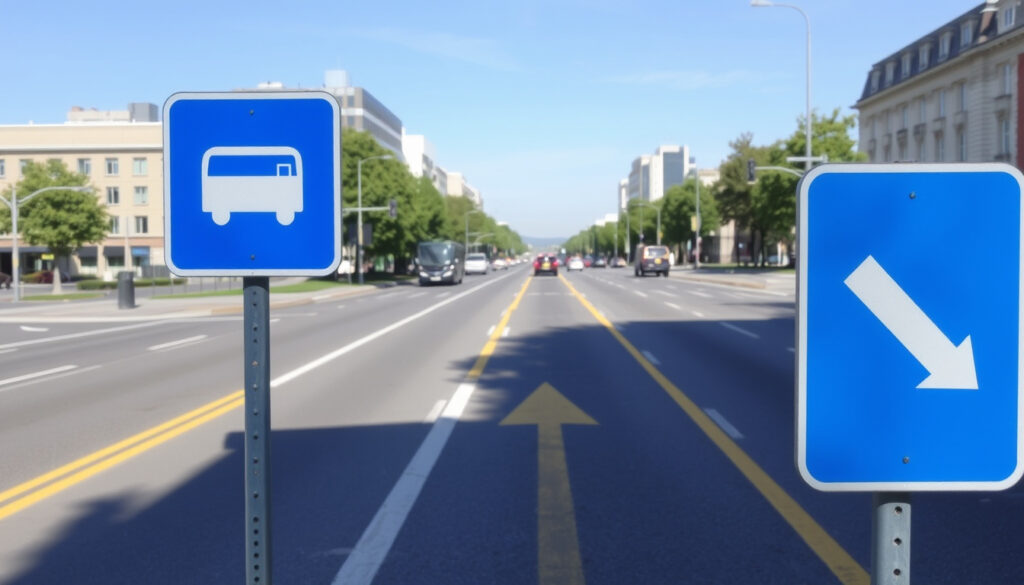
Common sign: Regulatory sign with bus and directional arrow ·
Primary risk: Collision with oncoming bus
Quick snapshot
- Bus lane opposite to main traffic flow (Irish Statute Book)
- Typically on one-way streets (Traffic Signs Manual)
- Buses only, no other vehicles (Garda Rules of the Road)
- Scheduled buses only (Irish Statute Book)
- No taxis, bicycles, or private cars (Garda Rules of the Road)
- Emergency vehicles not automatically allowed (Irish Statute Book)
- Regulatory sign with bus icon (Road Traffic (Signs) Regulations 2024)
- Direction arrow indicates travel (Road Traffic (Signs) Regulations 2024) (Road Traffic (Signs) Regulations 2024)
- Often includes text warning (Traffic Signs Manual) (Road Traffic (Signs) Regulations 2024)
- Direction: opposite vs same (Garda Rules of the Road)
- Users: more restricted for contra-flow (Irish Statute Book)
- With-flow may allow taxis/bicycles during hours (Irish Statute Book)
The key facts table below summarises the essential regulatory details for quick reference.
| Label | Value |
|---|---|
| Definition | A lane where buses travel in the opposite direction to other traffic (Irish Statute Book). |
| Primary Users (Ireland) | Buses on a scheduled service only (Irish Statute Book). |
| Common Location | One-way streets in urban areas (Traffic Signs Manual). |
| Sign Type | Regulatory rectangular sign with bus symbol and arrow (Road Traffic (Signs) Regulations 2024). |
| Other Vehicles | Not permitted, including taxis and Garda cars unless explicitly allowed (Garda Rules of the Road). |
What is a contra-flow bus lane?
Definition and basic principle
A contra‑flow bus lane is a lane marked so that vehicles travel in the direction opposite to the rest of the roadway. According to the Irish Statute Book (1979 regulations), it is a bus lane designated for traffic moving the opposite way. The Garda Rules of the Road describe it as a lane that “runs opposite the traffic beside it.”
How it differs from a regular bus lane
A regular bus lane (with‑flow) runs in the same direction as adjacent traffic. A contra‑flow lane goes the other way. The Traffic Signs Manual (2008) explains that a contra‑flow bus lane is effectively “a one‑way road with a bus lane running in the opposite direction.”
The direction reversal is the single most important fact for drivers: if you’re on a one‑way street and see a bus coming toward you, you’re likely next to a contra‑flow bus lane. Entering it puts you on a collision course with a bus.
What traffic may use a contra-flow bus lane?
Permitted vehicles: scheduled buses only
Irish law is explicit: “no traffic other than omnibuses and vehicles set out in bye‑laws for the bus lane may use a contra‑flow bus lane,” states the Irish Statute Book (1979 SI 413). Only buses operating on a scheduled service are allowed.
Vehicles not allowed
- Private cars (Irish Statute Book)
- Taxis (Irish Statute Book)
- Bicycles (unless the sign includes a cycle symbol, which is rare) (Traffic Signs Manual)
- Garda (police) cars are not automatically permitted unless local bye‑laws allow it (Garda Rules of the Road).
Are taxis, bicycles, or emergency vehicles permitted?
No. The Garda guidance states that a contra‑flow bus lane is “generally reserved only for buses, unless signs authorize cyclists.” Taxis are not mentioned as an exception. Emergency vehicles are not automatically permitted; they must rely on exemptions in local bye‑laws, which are uncommon.
Learner drivers often confuse contra‑flow with with‑flow lanes. In a with‑flow lane, taxis and cyclists are often allowed during operating hours. In a contra‑flow lane, the rule is stricter: only scheduled buses. Mistaking the two can lead to a fine and penalty points.
Where are contra-flow bus lanes found?
Typical locations: one‑way streets, city centres
Contra‑flow bus lanes are almost always on one‑way streets, according to the Traffic Signs Manual (Chapter 5). They are placed on the near side (the side nearest the kerb) and usually operate 24 hours a day. They are common in urban areas to give buses a shortcut through one‑way systems.
Examples in Ireland
Dublin, Cork, and Limerick all have contra‑flow bus lanes on busy one‑way streets. The exact locations are set by local bye‑laws and signed at the entrance and after every side‑road junction, as required by the Traffic Signs Manual.
How to identify them while driving
- Look for a rectangular regulatory sign with a bus symbol and an arrow pointing in the direction of bus travel (Road Traffic (Signs) Regulations 2024).
- The sign is placed at the start of the lane and repeated after every major junction (Traffic Signs Manual).
- Road markings: a solid white line with the word “BUS” and a directional arrow painted on the road.
The implication: if you see a bus coming toward you on a one‑way street, you have likely entered a contra‑flow bus lane. The safest move is to exit at the next available junction.
What is the difference between contra flow and with flow bus lanes?
Four features, one pattern: contra‑flow is more restrictive than with‑flow. The table below highlights the key contrasts.
| Feature | Contra-flow bus lane | With-flow bus lane |
|---|---|---|
| Direction of travel | Opposite to adjacent traffic (Garda Rules of the Road) | Same direction as adjacent traffic (Revised Acts – Bus Lanes) |
| Permitted users | Scheduled buses only (Irish Statute Book) | Buses, and often taxis and cyclists during operating hours (Irish Statute Book) |
| Operating hours | Usually 24 hours (Traffic Signs Manual) | Often limited to peak hours (displayed on the sign) (Irish Statute Book) |
| Signage | RUS 030 with RRM 024 (Road Traffic (Signs) Regulations 2024) | RUS 028 or RUS 029 with RRM 024 (Road Traffic (Signs) Regulations 2024) |
The trade‑off: contra‑flow lanes give buses a fast, direct route through one‑way systems, but they impose a total ban on non‑bus traffic. With‑flow lanes are more flexible, allowing taxis and cyclists when the lane is active, but they only work when traffic flows in the same direction.
What does a contra-flow bus lane sign look like?
Regulatory sign appearance
The sign is rectangular and regulatory. It shows a bus symbol with an arrow indicating the direction of the contra‑flow. The Road Traffic (Signs) Regulations 2024 identify it as sign RUS 030, used together with RRM 024 (the bus lane information plate).
Meaning of the arrow
The arrow on the sign points in the direction the bus lane travels. Because the lane runs opposite to the rest of traffic, the arrow will point the opposite way to the flow of the main carriageway. The Traffic Signs Manual (2008) notes that the bus symbol may be accompanied by a cycle symbol where pedal cycles are also permitted.
Where the sign is placed
Signs are placed at the start of the contra‑flow bus lane and after every side‑road junction, according to the Traffic Signs Manual. Additional signs must be provided if the distance between signs exceeds 300 m.
A contra‑flow bus lane sign is often the only warning you get before you enter the lane. If you miss it and drive into the lane, you face a collision with a bus and a penalty for improper use of a bus lane.
“In Ireland, a contra‑flow bus lane is a bus lane marked so vehicles in the lane travel in the direction opposite to the rest of the roadway.”
— Irish Statute Book (1979 Regulations)
“A contra‑flow bus lane runs opposite the traffic beside it and is generally reserved only for buses, unless signs authorize cyclists.”
Summary
For any driver in Ireland, the rule is clear: never enter a contra‑flow bus lane unless you are driving a scheduled bus. The penalty for misusing the lane can include fines and penalty points, and the risk of collision with a bus traveling opposite to the rest of traffic is serious. For learner drivers, the distinction between contra‑flow and with‑flow lanes is a common test trap. Driver must know the sign, know the rule, and stay out of the lane unless driving a bus.
irishtrafficsigns.com, bpdrivingschool.com, irishstatutebook.ie, assets.gov.ie, rennicks.ie, en.wikipedia.org
Understanding how a contra flow bus lane operates becomes clearer when you also review the with-flow bus lane rules for comparison.
Frequently asked questions
Can I drive in a contra‑flow bus lane if I need to turn?
No. You must not enter a contra‑flow bus lane even to turn. The only legal entry is for scheduled buses. Plan your route to avoid needing to turn across the lane.
Are bicycles allowed in a contra‑flow bus lane?
Only if the sign includes a cycle symbol. In Ireland, the Traffic Signs Manual says the bus symbol may be accompanied by a cycle symbol where pedal cycles are also permitted. Without that symbol, cyclists are not allowed.
Is a contra‑flow bus lane the same as a bus‑only street?
No. A bus‑only street is a fully pedestrianised street where only buses are allowed, while a contra‑flow bus lane is a lane on a one‑way street where buses travel opposite to the rest of traffic. The lane is part of a road that other vehicles can use in the main direction.
What is the penalty for using a contra‑flow bus lane illegally?
Penalties vary by local authority, but typically include a fixed‑charge notice and penalty points. In Dublin, the fine can be up to €80, and you may receive three penalty points. Check the specific bye‑laws for the area. Exact amounts may differ by jurisdiction.
Do the same rules apply in the UK?
Similar rules apply in the UK, but the signage and specific permitted users may differ. In the UK, contra‑flow bus lanes are also reserved for buses, but taxis and cyclists are sometimes allowed. Always check local regulations.
Can taxi drivers use a contra‑flow bus lane in any situation?
No. Taxis are not permitted in contra‑flow bus lanes in Ireland unless local bye‑laws specifically allow them. The Irish Statute Book states that only omnibuses (scheduled buses) and vehicles set out in bye‑laws may use the lane.
How do I recognize a contra‑flow bus lane at night?
Look for the regulatory sign, which is reflective. The road markings are also reflective: a solid white line with the word “BUS” and an arrow. If you see a bus coming toward you on what appears to be a one‑way street, you are likely in a contra‑flow bus lane.
More related posts
 Dublin to Barcelona Flight Time: Duration, Airlines & Tips
 Cork International Airport Hotel Review: Free Shuttle & Parking
 What to Eat Before Training: Best Foods & Timing Guide
 Mission: Impossible Dead Reckoning Part Two Delayed to May 2025
 Bank of Ireland Near Me – Branches, ATMs and Hours Guide
 BBC Radio 4 Schedules: Today, Tomorrow & Listen from Abroad
 Christopher Briney Movies and TV Shows: Filmography & More