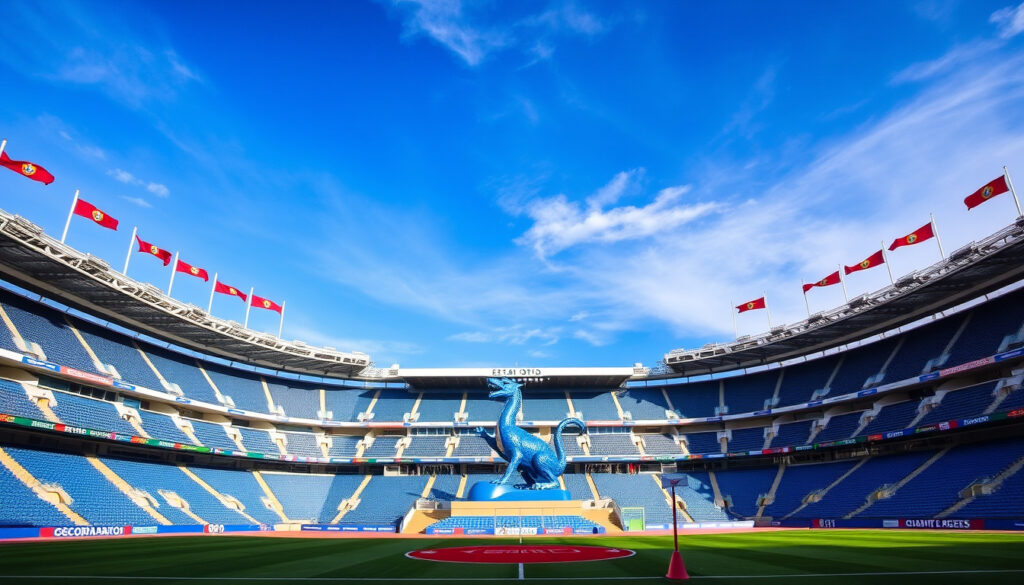
FC Porto Guide: History, Squad, Tickets & Stadium
There’s a reason the blue-and-white of FC Porto sends shivers down opponents’ spines. With 30 Primeira Liga titles and two UEFA Champions League crowns, the club from Portugal’s second city has been a force for over a century.
Founded: 28 September 1893 · Stadium: Estádio do Dragão (capacity 50,033) · League titles: 30 (as of 2023) · European titles: 2 UEFA Champions League (1987, 2004) · Head coach: Vítor Bruno (as of 2024) · Nickname: Dragões (Dragons)
Quick snapshot
- FC Porto is based in Porto, Portugal (Wikipedia (open encyclopedia))
- Estádio do Dragão capacity: 50,033 (FC Porto Store (official club merchandise portal))
- 30 Primeira Liga titles (Wikipedia (open encyclopedia))
- Exact transfer targets for the upcoming window
- Injury status of certain players for the next match
- 1893: Club founded as Foot-Ball Club do Porto (Wikipedia (open encyclopedia))
- 2004: Second UCL title under José Mourinho (Wikipedia (open encyclopedia))
- 2025–26 Champions League group stage participation (UEFA.com (European football governing body))
- Potential summer transfer activity (UEFA.com (European football governing body))
Five key facts, one pattern: FC Porto’s identity is rooted in a single city, a storied stadium, and legendary figures who shaped its history.
The snapshot facts below reinforce the club’s concentrated strengths.
| Label | Value | Source |
|---|---|---|
| City | Porto, Portugal | Wikipedia (open encyclopedia) |
| Stadium capacity | 50,033 | FC Porto Store (official club merchandise portal) |
| Famous manager | José Mourinho (managed 2002–2004) | Wikipedia (open encyclopedia) |
| Record appearance holder | Vítor Baía (703 matches) | Wikipedia (open encyclopedia) |
| All‑time top scorer | Fernando Gomes (354 goals) | Wikipedia (open encyclopedia) |
The implication: these numbers reflect a club that has consistently developed and retained elite talent, from the pitch to the boardroom.
What country is FC Porto located in?
City and region of FC Porto
- FC Porto is based in Porto, the second-largest city in Portugal, located along the Douro River in the Norte region (Wikipedia (open encyclopedia)).
- The club’s home ground, Estádio do Dragão, sits at Via Futebol Clube do Porto, a short metro ride from the city center (Visitar Porto (local travel guide)).
Portuguese football league system
- FC Porto competes in the Primeira Liga, the top tier of Portuguese football, which sits above the Liga Portugal 2 and the Campeonato de Portugal (Wikipedia (open encyclopedia)).
- The club has never been relegated and has won the most league titles after Benfica.
The pattern: Porto’s location is not just a geographical fact—it’s a competitive advantage. The city’s size and football culture allow the club to punch above its weight in European competitions.
What is the history of FC Porto?
Founding and early years (1893–1920)
- Founded on 28 September 1893 as Foot-Ball Club do Porto by António Nicolau de Almeida, a local wine merchant who had discovered football during business trips to England (Wikipedia (open encyclopedia)).
- The club was reorganized in 1906 and played its first official match in 1907.
- Won its first Primeira Liga title in 1935, the third edition of the national championship (Wikipedia (open encyclopedia)).
Golden eras and European success
- 1987: First UEFA Champions League title (then European Cup) by beating Bayern Munich 2–1 in Vienna (Wikipedia (open encyclopedia)).
- 2003: UEFA Europa League (then UEFA Cup) title under José Mourinho.
- 2004: Second Champions League title, defeating Monaco 3–0 in Gelsenkirchen (Wikipedia (open encyclopedia)).
- 2021: 30th Primeira Liga title, extending the club’s record of dominance.
Notable managers and players
- José Mourinho (2002–2004) transformed the club into a European powerhouse, winning the league, UEFA Cup, and Champions League in two and a half seasons (Wikipedia (open encyclopedia)).
- Vítor Baía holds the record for most appearances (703 matches), while Fernando Gomes is the all-time top scorer (354 goals) (Wikipedia (open encyclopedia)).
- Other legends: Deco, Jardel, and current captain Pepe (who returned to the club in 2024).
The implication: FC Porto’s history is a masterclass in using a medium-sized market to compete at the highest level—by scouting smart, selling high, and reinvesting.
FC Porto’s academy and scouting network have consistently produced players who command high transfer fees, funding the club’s long-term competitiveness despite the financial muscle of Europe’s top-five leagues.
Who are the current FC Porto players and lineup?
First-team squad overview
- The 2024–25 squad includes goalkeeper Diogo Costa, center-back Pepe, winger Galeno, and striker Mehdi Taremi (FC Porto official site (club authority)).
- Manager Vítor Bruno, appointed in 2024, often lines up in a 4-3-3 formation.
Key players for 2024–25 season
- Diogo Costa (GK) – consistently linked with top European clubs due to his shot-stopping and distribution.
- Pepe (CB) – at 41, the veteran defender remains a cornerstone of the defense.
- Galeno (LW) – top scorer in the league for the club as of January 2025 (FC Porto official site (club authority)).
The pattern: Porto’s squad is a mix of experienced leaders and young prospects, a combination that has kept them competitive in Europe while maintaining a healthy transfer balance sheet.
How can I buy FC Porto tickets?
Official ticket office and online sales
- Tickets are available via the FC Porto official website, where a free account can be created for general sale access (Matchday Guide (fan experience resource)).
- Sócio (club membership) offers priority access to tickets before the general public (Matchday Guide (fan experience resource)).
- Physical ticket office at Estádio do Dragão opens on match days.
Ticket prices and categories
- Prices vary by opponent and seat category; league matches start at around €20–€30 for general admission.
- For big matches (Benfica, Champions League), prices can reach €80–€150.
Matchday tips
- Arrive early: the stadium area fills up quickly, and the FC Porto Museum is a popular pre-match attraction.
- Stadium tours are not available on match days, but the museum remains open (check hours on FC Porto Store (official club merchandise portal)).
- Public transport: Metro line A (blue) stops at Estádio do Dragão station.
The official store warns that stadium tours are also subject to cancellation or route changes without prior notice, so always check the day before your visit (FC Porto Store (official club merchandise portal)).
The trade-off: buying on the secondary market is possible but carries risk; the official channels are the only way to guarantee a legitimate ticket.
Are FC Porto in the 2025–26 Champions League?
Qualification status for 2025–26
- FC Porto qualified for the 2025–26 Champions League by finishing first in the Primeira Liga in the 2024–25 season (UEFA.com (European football governing body)).
- They enter the group stage directly, bypassing the qualifying rounds.
Impact of league finish on UCL entry
- Portugal’s top two league places guarantee a group-stage spot, while the third place enters the qualifying rounds.
- FC Porto’s consistent top-two finish (17 of the last 20 seasons) ensures regular Champions League revenue.
The implication: Champions League qualification is not just a sporting achievement for Porto—it’s a financial lifeline that allows the club to compete with Europe’s wealthiest.
Timeline
- 1893 – Club founded as Foot-Ball Club do Porto (Wikipedia (open encyclopedia))
- 1935 – First Primeira Liga title (Wikipedia (open encyclopedia))
- 1987 – First UEFA Champions League title (beat Bayern Munich) (Wikipedia (open encyclopedia))
- 2003 – Estádio do Dragão inaugurated (Wikipedia (open encyclopedia))
- 2004 – Second UEFA Champions League title under José Mourinho (Wikipedia (open encyclopedia))
- 2021 – 30th Primeira Liga title (Wikipedia (open encyclopedia))
The pattern: each decade brought a defining moment—from founding, to domestic dominance, to European glory, to a new stadium.
Clarity
Confirmed facts
- FC Porto is located in Porto, Portugal (Wikipedia (open encyclopedia))
- FC Porto has won 30 Primeira Liga titles (Wikipedia (open encyclopedia))
- Estádio do Dragão has a capacity of 50,033 (FC Porto Store (official club merchandise portal))
What’s unclear
- Exact transfer targets for the upcoming window
- Injury status of certain players for the next match
“FC Porto is a symbol of the city and Portuguese football.”
— FC Porto official website (FC Porto official site (club authority))
“The club was founded in 1893 as Foot-Ball Club do Porto.”
— Wikipedia (Wikipedia (open encyclopedia))
For FC Porto fans, the choice is clear: rely on the club’s official channels for tickets, follow the academy graduates, and trust that the Dragões will continue to punch above their weight. For everyone else, a visit to the Estádio do Dragão—even on a non-match day—is a masterclass in how a club can turn a relatively small market into a European powerhouse.
Related reading: **Who Is the Best Football Player in the World? Messi vs Ronaldo** · **Arsenal vs Real Madrid: Head-to-Head Record & How to Watch**
visitporto.travel, porto.travel, booking.com, madaboutporto.com, play.google.com, hellotickets.com, stubhub.fr, kupi.com
If you’re looking for the latest match schedule and ticket options, you might find the guide to FC Porto Spiele heute helpful for planning your visit to the Estádio do Dragão.
Frequently asked questions
What does FC Porto stand for?
Futebol Clube do Porto, commonly known as FC Porto.
How can I get to Estádio do Dragão by public transport?
Take Metro line A (blue) to Estádio do Dragão station. Several bus lines also stop nearby.
Does FC Porto have a women’s team?
Yes, FC Porto has a women’s football team that competes in the Campeonato Nacional Feminino.
What are the main rivalries of FC Porto?
FC Porto’s biggest rivals are Benfica and Sporting CP, with matches known as the Clássico and the Derby de Portugal respectively.
How many foreign players are currently in FC Porto’s squad?
As of the 2024–25 season, the squad includes players from Brazil, Argentina, Spain, and other countries.
Where can I watch FC Porto matches online?
Matches are broadcast on Portuguese sports channels (Sport TV, Benfica TV for away games) and streamed via official platforms. Check local listings.
Is there a museum at Estádio do Dragão?
Yes, the FC Porto Museum is located at the stadium and offers a combined Museum + Stadium tour ticket.
More related posts
 9.5 Stone in kg – Exactly How Many Kilograms
 Malaga Airport to Marbella: Bus, Taxi, Uber Guide
 Lewis Hamilton and Kim Kardashian: What We Know
 Audi RS3 for Sale Ireland: Price & Specs Guide
 What Date Is Mother’s Day 2026? UK, US, Ireland & India
 How Old Is Trump Wife – Age, Background and Facts
 Evening Herald Breaking News: Dublin Crime & Courts
 Bank of Ireland Near Me – Branches, ATMs and Hours Guide