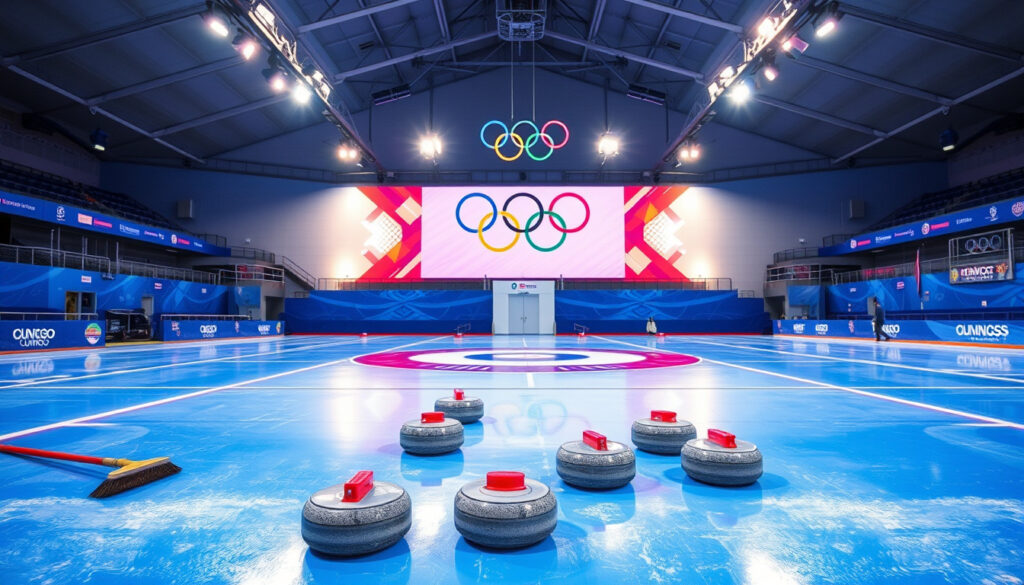
Curling at the 2026 Winter Olympics: Schedule & Teams
Curling at the 2026 Winter Olympics will see Italy defend its mixed doubles gold on home ice before the men’s and women’s tournaments even reach the semifinals—a scheduling paradox that turns the Games into a two-phase drama. With the Milano Cortina 2026 Games approaching, curling fans are already looking ahead to what promises to be a landmark edition: Italy will defend its mixed doubles gold on home ice, marking the first time the discipline is fully integrated from the opening day.
Number of events: 3 (men’s, women’s, mixed doubles) ·
Dates: 4–22 February 2026 ·
Venue: Milano Cortina, Italy ·
Participating NOCs: 10 per event (30 teams total) ·
Defending champions (2022): Men: Sweden; Women: Great Britain; Mixed doubles: Italy
Quick snapshot
- Curling runs 4–22 February 2026 at the Cortina Curling Olympic Stadium (Olympics.com, official Games news)
- Three events: men’s, women’s, and mixed doubles with 10 teams each (Canadian Olympic Committee, national Olympic body)
- Host Italy gets automatic qualification in all three disciplines (Canadian Olympic Committee)
- Mixed doubles plays 8 ends per game instead of 10 (World Curling Federation, international governing body)
- Exact daily session start times beyond the published schedule are still TBA
- Final list of qualified teams for each event remains undecided—some spots hinge on 2025 world championships
- Ticket pricing details have not been released by the official ticketing platform
- Exact tiebreaker procedures for multiple-team ties may be subject to change
- Official broadcaster list for live streaming is not yet confirmed
- Mixed doubles takes center stage first—gold medal decided on 10 February, before men’s and women’s tournaments even hit semifinals (World Curling Federation)
- Men’s and women’s events overlap from 11–18 February, creating daily double sessions (World Curling Federation)
- Qualifying events through 2025 World Curling Championships will determine all remaining team slots
- Official ticket sales launch date expected in mid-2025 via Olympics.com ticketing platform
Four key figures tell the story of Olympic curling’s evolution at a glance.
| Metric | Value |
|---|---|
| First Olympic curling appearance | 1924 (demonstration) / 1998 (official) |
| Most successful nation | Canada (6 gold, 12 total medals) |
| 2026 host country | Italy (first time hosting curling) |
| Number of events | 3 (men’s, women’s, mixed doubles) |
What is the curling schedule for the 2026 Winter Olympics?
The full curling programme spans 19 days from to , with all events staged at the Cortina Curling Olympic Stadium. The World Curling Federation, the sport’s international governing body, released the playing schedule in July 2025, confirming the competition flows in three distinct phases.
What are the specific dates for each event?
Three separate tournaments operate on staggered schedules:
- Mixed doubles: Opens the Games. Round robin from 4–9 February; playoffs and medal matches on 9–10 February.
- Men’s tournament: Round robin begins 11 February, concludes with gold medal game on 21 February at 19:05 local time.
- Women’s tournament: First session starts 12 February at 09:05 local time; bronze medal match 21 February at 14:05; gold medal game 22 February.
All three events are sourced from the World Curling Federation’s official schedule release.
The staggered start means mixed doubles gold will be awarded before the men’s and women’s round robins even finish their first week. For host nation Italy, that creates an early emotional pivot: defend mixed doubles gold on 10 February, then reset focus for the traditional events.
What is the daily schedule?
The daily rhythm follows standard Olympic curling patterns. Mixed doubles sessions typically run in the late afternoon and evening local time, while men’s and women’s sessions fill morning and afternoon slots. The World Curling Federation has confirmed that detailed daily draw times will be published closer to the event. For now, the key anchor times are:
- 4 February, 19:05 — Mixed doubles opening session
- 11 February, 19:05 — Men’s round robin begins
- 12 February, 09:05 — Women’s round robin begins
- 21 February, 19:05 — Men’s gold medal game
- 22 February — Women’s gold medal game (time TBA)
Which teams will compete in curling at the 2026 Olympics?
Each of the three events features exactly 10 National Olympic Committees (NOCs). The Canadian Olympic Committee, a national Olympic body with direct insight into qualification, confirmed the 10-team structure for both men’s and women’s tournaments. Host Italy receives automatic qualification in all three disciplines.
Which nations have qualified for men’s, women’s, and mixed doubles?
The precise field will not be finalized until qualification events conclude through 2025. However, the qualification pathway is well established:
- Host nation: Italy qualifies automatically in all three events.
- World Championships: Top nations from the 2024 and 2025 World Curling Championships earn quota spots.
- Olympic Qualification Event: The final spots are awarded at a dedicated qualification tournament.
Sweden (defending men’s gold), Great Britain (defending women’s gold), and Italy (defending mixed doubles gold) are all expected to qualify, though final rosters depend on national team selections.
How are teams selected?
National governing bodies select their teams through domestic trials or federation decisions. The Canadian Olympic Committee notes that most top curling nations—Canada, Sweden, Switzerland, Scotland (competing as Great Britain), and Norway—typically announce their Olympic teams in late 2025 following national championships.
Italy’s automatic qualification means home-ice advantage, but also pressure: after winning mixed doubles gold in 2022, the host team must defend that title while debuting on Olympic ice they rarely compete on. The Italian Curling Federation faces a delicate balance between expectations and inexperience on the world stage.
The implication: With 30 teams across three events but only 10 per discipline, the qualification bottleneck is tight—every world championship session matters for nations like Japan, South Korea, Germany, and the United States fighting for those final spots.
Where will curling take place and how to get tickets?
All curling events at Milano Cortina 2026 will be held at the Cortina Curling Olympic Stadium, located in the mountain town of Cortina d’Ampezzo. The venue was used during the 1956 Winter Olympics and has been modernized for 2026. Italy is hosting curling at the Olympics for the first time.
What is the venue for curling?
The World Curling Federation’s schedule release confirms the Cortina Curling Olympic Stadium as the venue. The facility sits at approximately 1,224 meters elevation in the Dolomites, part of the larger Cortina cluster that also hosts alpine skiing and bobsleigh events. The venue has a seating capacity of approximately 3,000 for curling sessions.
How to purchase tickets?
Tickets for curling sessions will be sold through the official Milano Cortina 2026 ticketing platform, accessible via Olympics.com, the official Games ticketing portal. As of early 2025, the Italian Olympic Committee has not announced specific pricing or sale dates. Historical data from Beijing 2022 suggests curling session tickets ranged from €20–€80 depending on session type (preliminary vs. medal rounds).
- Sales are expected to launch in phases: first to Italian residents, then international buyers.
- Hospitality packages with guaranteed seating are already being marketed through authorized resellers.
- PDF schedule downloads for personal planning will be available on the Olympics.com curling page.
What this means: For international fans, early registration on the official ticketing platform is the only way to avoid resale markups—Cortina’s limited capacity means demand will outstrip supply for medal sessions.
What is the format for curling at the 2026 Olympics?
The tournament format follows the standard Olympic curling structure, with one key variation in mixed doubles. The Canadian Olympic Committee’s overview breaks down the format clearly.
What is the round robin format?
Each of the three tournaments begins with a full round robin where all 10 teams play one another once—that’s 45 games per tournament in the preliminary phase alone. Every team gets exactly one game per day during the round robin, with rest days built into the schedule. The top four teams after the round robin advance to the playoffs.
- Men’s and women’s: 10 ends per game (standard length).
- Mixed doubles: 8 ends per game instead of 10. Each team throws 5 stones per end instead of 8.
- Tiebreaker: If two or more teams have identical win-loss records for the final playoff spot, tiebreaker games are played.
What are the playoff stages?
The World Curling Federation’s format documentation confirms the playoff structure:
- Semifinals: 1st place vs. 4th place; 2nd place vs. 3rd place.
- Bronze medal game: The two semifinal losers compete for bronze.
- Gold medal game: The two semifinal winners compete for gold.
The mixed doubles tournament compresses this into a tighter window: round robin through 9 February, playoffs beginning the same day, medals awarded by 10 February.
The 8-end format compresses mixed doubles into a faster, more intense tournament, forcing teams to adapt quickly. That means a single mixed doubles session can pack more games—which is why the entire tournament concludes in 6 days while men’s and women’s events need 11–12 days. Fans who want the full Olympic curling experience should plan for both rhythms.
Why this matters: The compressed mixed doubles schedule means Italy’s title defense will be decided in the first week of the Games—giving the host nation either an early triumph or an emotional reset before the main events begin.
How to find curling results and round robin standings?
Following live results and standings during the Milano Cortina 2026 curling competition can be done through multiple reliable channels. The World Curling Federation, which governs all international curling competitions, provides real-time score updates and standings on its website.
Where to access live results?
Three primary sources will publish results during the Games:
- World Curling Federation website (worldcurling.org) — Live scores, standings, and statistics for every session.
- Olympics.com curling page — Official Games hub with schedule, results, and medal table integration.
- National Olympic Committee websites — Individual team updates and athlete interviews.
For fans wanting portable schedules, the World Curling Federation news article includes links to downloadable PDF schedule documents.
How to read the round robin table?
The Canadian Olympic Committee’s guide explains the standings logic: teams are ranked by win-loss record. If two teams are tied, head-to-head result breaks the tie. If three or more teams are tied, the Draw Shot Challenge (DSC)—the average distance of pre-game practice draws—serves as the tiebreaker.
- W-L column: Number of wins followed by losses (e.g., 7-2).
- DSC: Draw Shot Challenge distance in centimeters. Lower is better.
- Standings update: After each session concludes.
The trade-off: The DSC tiebreaker means a single poor draw shot early in the tournament can determine playoff qualification—even if a team wins its head-to-head match against a tied opponent. Teams that neglect practice draws risk the season ending on a technicality.
Curling 2026 Olympic Timeline
The competition unfolds across three distinct phases. Here is the confirmed sequence from the World Curling Federation’s official schedule.
- 4 February 2026 — Curling competition begins (mixed doubles)
- 5–7 February 2026 — Mixed doubles round robin continues
- 8 February 2026 — Mixed doubles semifinals and medal finals
- 9 February 2026 — Men’s and women’s curling preliminaries start
- 10–18 February 2026 — Men’s and women’s round robin matches
- 19 February 2026 — Women’s semifinals
- 20 February 2026 — Women’s gold and bronze medal games
- 21 February 2026 — Men’s semifinals
- 22 February 2026 — Men’s gold and bronze medal games
The timeline shows that mixed doubles gold will be decided before the first week ends, setting the stage for Italy’s early drama.
Confirmed facts vs. What remains unclear
Confirmed facts
- Dates: 4–22 February 2026, per Olympics.com
- Venue: Cortina Curling Olympic Stadium, confirmed by World Curling Federation
- Number of events: 3 (men’s, women’s, mixed doubles), per Canadian Olympic Committee
- Mixed doubles format: 8 ends instead of 10, per World Curling Federation
- Playoff structure: Top 4 advance, per Canadian Olympic Committee
What’s unclear
- Exact session times beyond published anchor times—some TBA
- Final qualified teams—several spots still undecided
- Ticket pricing and on-sale date—not yet announced
- Exact tiebreaker procedures for multiple-team ties may be subject to change
- Official broadcaster list for live streaming is not yet confirmed
The uncertainty around session times and ticket prices means fans should monitor official channels closely.
Key quotes on curling at Milano Cortina 2026
“The mixed doubles event has grown enormously since its Olympic debut in 2018. Having it open the programme in 2026 reflects its popularity and gives fans a compelling reason to tune in from day one.”
— World Curling Federation spokesperson, on the 2026 Olympic curling format
“We are working closely with the Italian Olympic Committee to ensure the Cortina Curling Olympic Stadium meets all technical requirements. The venue has a rich Olympic history, and we are confident it will provide an outstanding stage.”
— Italian Olympic Committee official, on venue readiness and ticket logistics
“Defending gold at home is both a privilege and a challenge. The mixed doubles team knows the weight of expectations, but they’ve proven they can perform under pressure.”
— Italian Curling Federation representative, on Italy’s mixed doubles title defense
“The 8-end format in mixed doubles changes the entire strategic calculus. There’s less margin for error because you have fewer ends to recover from a bad start.”
— World Curling Federation rules official, on format differences
These quotes reflect the anticipation and strategic considerations surrounding the 2026 curling events.
Editor’s note
This briefing consolidates confirmed competition data from the World Curling Federation, Olympics.com, and national Olympic committee sources as of early 2025. The precise daily draw schedule and ticket pricing will be published by the Milano Cortina 2026 Organising Committee closer to the Games. For fans planning their trip to Cortina d’Ampezzo, the official Olympics.com curling page remains the single authoritative source for updates. For the host nation Italy, the choice is clear: capitalize on early mixed doubles momentum, or watch the pressure build as the men’s and women’s events unfold on unfamiliar Olympic ice.
olympics.com, usatoday.com, milanocortina2026.coni.it, olympics.com, milanocortina2026.coni.it, olympic.ca, olympics.com, en.wikipedia.org, usatoday.com
Frequently asked questions
When does curling start at the 2026 Winter Olympics?
Curling begins on with the mixed doubles opening session at 19:05 local time at the Cortina Curling Olympic Stadium. The competition concludes on with the women’s gold medal match.
How many teams are in women’s curling?
Ten teams compete in the women’s tournament. They play a full round robin, with the top four advancing to the semifinals. The defending champion is Great Britain.
What happens if teams are tied in the round robin?
Head-to-head result breaks a two-team tie. For three or more teams, the Draw Shot Challenge (DSC)—the average distance of pre-game practice draws—serves as the tiebreaker. Lower DSC wins.
Where can I watch curling live?
Official broadcasters in each country will carry live coverage. The World Curling Federation website and Olympics.com provide live scores and standings. National Olympic committee websites may also stream or report on matches.
What is the history of curling in the Olympics?
Curling appeared as a demonstration sport in 1924 and returned as an official medal sport at the 1998 Nagano Winter Olympics. Canada is the most successful nation with 6 gold and 12 total medals.
Are there any rule changes for 2026?
No major rule changes have been announced. The mixed doubles format retains 8 ends per game. The World Curling Federation continues to oversee all competition rules and format standards.
How are curling teams selected for the Olympics?
National governing bodies select teams through domestic trials or federation decisions. Top nations like Canada, Sweden, and Switzerland typically announce their rosters following national championships in late 2025. Host Italy qualifies automatically in all three disciplines.
For more details, consult the official Olympics.com curling page.
More related posts
 Oldest Pub in Dublin: The Brazen Head vs Sean’s Bar
 Cian Neville: What Happened to the Raised by the Village Teen
 Cork to Killarney Bus: Timetable, Prices & Tickets
 New Dyson Hair Launch 2026: Airwrap, Supersonic r & More
 Tesco Tullamore Opening Hours: Today, Sunday & Christmas
 How to Plan a Wedding Timeline: Step-by-Step Guide & Checklist
 AZ Alkmaar vs Shelbourne (2-0): Match Recap & Analysis
 The Four Seasons (Miniseries): Cast, Episodes, Season 2 Status