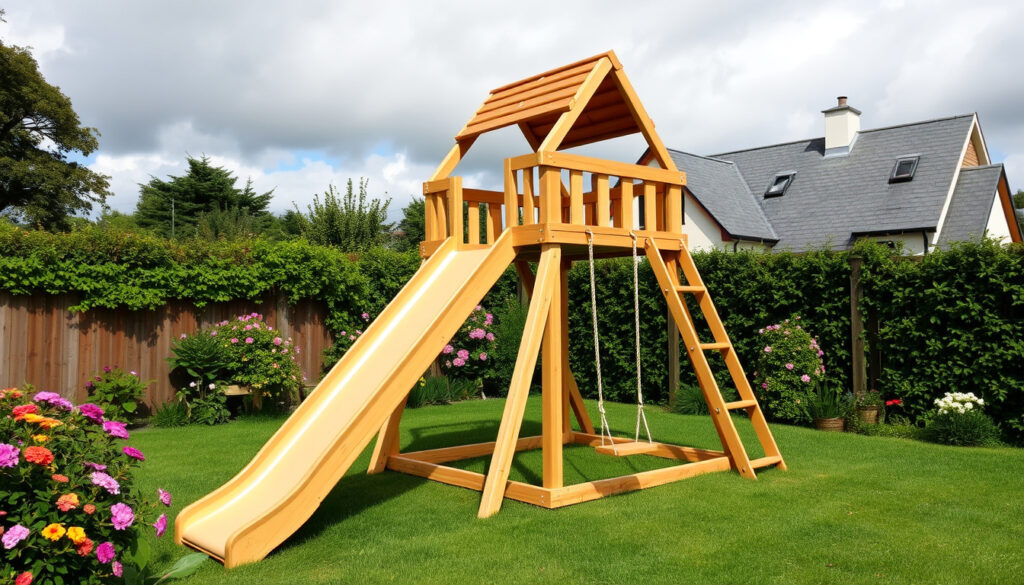
Climbing Frames for Kids: Best Options for Irish Homes 2025
For Irish parents, a garden climbing frame is often the single biggest play investment they’ll make. Between the variable weather, limited space on many plots, and the range of wooden, metal, and plastic models available, choosing the right one takes more than a quick scroll through an online store. This guide breaks down what actually matters — safety standards, material durability, and where to buy in Ireland — so you can find a frame that lasts through the seasons.
Average price range (wooden frames): €250–€800 ·
Most common frame material: Wood ·
Minimum safety standard: EN 71 (European Toy Safety) ·
Popular additional features: Slides, swings, climbing walls ·
Average assembly time: 2–5 hours
Quick snapshot
- Indoor frames are compact, lightweight, often foam-based (Outdoor Toys specialist retailer)
- Outdoor frames are larger, weatherproof, and require anchoring (Jungle Gym Ireland Irish play equipment retailer)
- Wood: natural look, durable, requires treatment (TP Toys UK-based play equipment specialist)
- Metal: lightweight, rust-resistant, can heat in sun (TP Toys UK-based play equipment specialist)
- Plastic: budget-friendly, limited weight capacity (TP Toys UK-based play equipment specialist)
- EN 71 (European Toy Safety) — mandatory for domestic frames in the EU (Climbing Frame Installer UK installation specialist)
- EN 1176 — required for commercial/school equipment (Sportsafe UK school play equipment consultant)
- GS mark (German safety) and ASTM (US standard) for imports (Climbing Frame Installer UK installation specialist)
- Slides, swings, climbing walls, sandboxes (Jungle Gym Ireland Irish play equipment retailer)
- Canopies for sun protection (Jungle Gym Ireland Irish play equipment retailer)
- Adjustable height for growing children (Jungle Gym Ireland Irish play equipment retailer)
Five key specs that separate a climbing frame that will last from one that wobbles by spring.
| Spec | Value |
|---|---|
| Recommended age range | 3 to 10 years (Sportsafe UK school play equipment consultant) |
| Maximum user weight (typical) | 50 kg per child |
| Common frame materials | Wood (pine, cedar, eucalyptus), metal (galvanized steel), plastic (HDPE) (TP Toys UK-based play equipment specialist) |
| Average lifespan (wooden) | 5–8 years with proper care (TP Toys UK-based play equipment specialist) |
| Assembly required | Yes, typically 2–5 hours (Jungle Gym Ireland Irish play equipment retailer) |
What are the best indoor climbing frames for kids?
Key features of indoor climbing frames
- Indoor climbing frames are typically smaller and designed for limited space (Outdoor Toys specialist retailer)
- Common materials include foam, plastic, and lightweight wood
- Frames with non-slip bases and soft edges reduce injury risk (TP Toys UK-based play equipment specialist)
Indoor frames trade size for safety. Most are built from foam or lightweight plastic and sit low to the ground, which makes them suitable for living rooms and playrooms. TP Toys recommends checking that any indoor frame has non-slip bases and rounded edges — small details that matter when a frame is used on hardwood or tiled floors. The trade-off is clear: indoor frames offer less climbing height and fewer add-ons than their outdoor counterparts, but they keep children active year-round regardless of Irish weather.
Space considerations for indoor use
- Measure ceiling height and floor area before purchase
- Leave at least 1 metre of clearance around the frame for safe play (TP Toys UK-based play equipment specialist)
- Corner units and foldable models save space in smaller rooms
Irish homes, particularly terraced houses and apartments, rarely have spare floor space for a full-size climbing frame. A compact corner unit or a foldable foam climber can fit into a 2m × 2m space. TP Toys advises leaving a buffer zone so children don’t knock into furniture or walls during active play. The implication for Irish buyers: measure twice, buy once. An indoor frame that doesn’t fit the room becomes a hazard, not a toy.
Indoor frames keep kids moving on rainy days, but they limit climbing height and rarely include swings or slides. An indoor frame is a supplement, not a replacement, for outdoor play equipment — particularly for children over 5 who crave real climbing challenges.
The takeaway: Irish parents with limited indoor space should prioritise compact foam climbers for toddlers and accept that indoor frames are a rainy-day solution, not a full play system.
What are the best outdoor climbing frames for kids?
Weather-resistant materials
- Outdoor frames are built from treated wood or galvanized metal to withstand rain (TP Toys UK-based play equipment specialist)
- Wooden frames require annual re-treatment to prevent rot (TP Toys UK-based play equipment specialist)
- Galvanised or powder-coated steel resists rust and corrosion (TP Toys UK-based play equipment specialist)
Ireland’s damp climate is the real test. TP Toys stresses that wooden frames need outdoor-treated timber and regular staining or sealing to preserve strength and longevity. Metal frames should use galvanised or powder-coated steel — bare steel will rust within two Irish winters. The pattern is consistent: wood offers a natural look and feels warmer to the touch, but demands maintenance. Metal is lower upkeep but can heat up in direct sun and needs solid anchoring to prevent tipping.
Popular configurations: slides, swings, climbing walls
- Many include multiple play activities to encourage active play (Jungle Gym Ireland Irish play equipment retailer)
- Anchoring the frame to the ground is recommended for stability (Jungle Gym Ireland Irish play equipment retailer)
- Combination units (slide + swing + climbing wall) offer the best value for space
Jungle Gym Ireland includes ground anchors, bumper pads, and handgrips as standard on its wooden frames — practical features that address the two biggest outdoor risks: tipping and impact. A frame that combines a slide, a swing, and a climbing wall typically uses the same footprint as a basic climber but triples the play options. For Irish gardens, where space is often at a premium, that combination makes the difference between a toy children outgrow in a year and one they use for half a decade.
Outdoor frames with multiple add-ons increase the fall risk. Sportsafe UK notes that mats at the base of climbing equipment “may have limited ability to reduce the impact of a low-level accidental fall” and cannot prevent head injury or concussion. Anchoring and soft landing surfaces matter more than the number of features.
The takeaway: Irish families should anchor any outdoor frame over 1 metre high and budget for impact-absorbing surfacing beneath it — features, not the frame height, will keep children safe.
Where can I buy climbing frames for kids in Ireland?
Online retailers specializing in garden play equipment
- Major Irish retailers include JungleGym, Wickey, FatMoose, and AllAboutOutdoors
- Free delivery is common from online stores
- JungleGym.ie says its wooden frames meet the European safety standard EN 71-8 (Jungle Gym Ireland Irish play equipment retailer)
The Irish market for climbing frames is dominated by a handful of specialist retailers. JungleGym.ie, Wickey.ie, FatMoose.ie, and AllAboutOutdoors.ie collectively account for most online sales of wooden and metal frames to Irish households. Most offer free delivery within Ireland, which can save €30–€60 on a bulky item. JungleGym explicitly states that its frames are designed to comply with EN 71-8, which should give Irish buyers confidence that they aren’t importing substandard equipment.
Local stores and second-hand options
- Second-hand options are available on DoneDeal and local marketplaces
- Check second-hand frames for rust, rot, or missing parts before buying
- Local toy and garden centres sometimes carry smaller frames
DoneDeal and Facebook Marketplace regularly list used climbing frames from Irish families whose children have outgrown them. A second-hand wooden frame can cost €100–€300, but the risk is hidden damage: rot in the base posts, rusted bolts, or weathered wood that no longer meets safety standards. TP Toys recommends inspecting any used frame for smooth, rounded edges and welded joints — signs that it was well-made and well-maintained. For buyers on a budget, a second-hand metal frame that has been powder-coated and stored dry can be a safe bet. For wooden frames, the safer route is new.
Irish buyers face a choice: pay €250–€800 for a new frame with a warranty and known safety certification, or risk a second-hand frame that may have unseen structural wear. For families with toddlers, the premium for new equipment is usually worth it.
The takeaway: Irish parents should buy new from JungleGym or Wickey for warranty coverage and verified EN 71 compliance, and only consider second-hand metal frames that show no rust.
Are metal climbing frames safe for children?
Metal vs wooden frames: durability and safety
- Metal frames should have rounded edges and be free from sharp burrs (TP Toys UK-based play equipment specialist)
- Metal frames are often lighter and more prone to tipping if not anchored (Jungle Gym Ireland Irish play equipment retailer)
- Galvanized steel resists rust and is a durable choice (TP Toys UK-based play equipment specialist)
Metal frames divide opinion among parents. They are lighter, cheaper, and easier to move than wooden frames, but they are also more prone to tipping on uneven ground and can develop sharp edges if the coating degrades. TP Toys advises that buyers look for smooth, rounded edges and welded joints rather than bolted connections, which can loosen over time. Galvanised steel is the gold standard — it resists rust even in wet climates. The pattern: metal frames need vigilant anchoring and regular inspection, but they last longer than budget plastic models and cost less than premium wood.
Safety features to look for
- EN 71 compliance is the baseline for domestic frames sold in the EU (Climbing Frame Installer UK installation specialist)
- Ground anchors, bumper pads, and handgrips reduce common risks (Jungle Gym Ireland Irish play equipment retailer)
- Soft landing surfaces are encouraged but not legally required for domestic frames (Climbing Frame Installer UK installation specialist)
Domestic climbing frames sold in Ireland must meet EN 71 — the European Toy Safety Directive. That standard covers mechanical and physical properties, including sharp edges, entrapment risks, and structural stability. Climbing Frame Installer notes that commercial-grade equipment (schools, playgrounds) must meet the stricter EN 1176, which mandates impact-absorbing surfaces for any frame over 1 metre. For domestic buyers, safety surfaces are recommended but not required. The implication: a home frame with a 1.5-metre platform and no soft landing zone is legal but risky. Irish parents should budget for rubber mats or bark chips beneath any frame over 1 metre high.
The takeaway: Irish parents who choose metal frames must anchor them and inspect for sharp edges annually — the weight savings don’t outweigh the tipping risk if installation is skipped.
How to choose a climbing frame for a small garden?
Space measurement and layout planning
- Measure available space and leave buffer zones for safe play (TP Toys UK-based play equipment specialist)
- Corner units or foldable models save space
- Look for frames that combine slide, swing, and climbing wall in one unit
Irish gardens average around 50–80 square metres for modern housing estates, which means a climbing frame often competes with a patio, a shed, and a lawn. TP Toys recommends measuring the full swing arc and adding a 1-metre buffer zone on all sides. A typical A-frame with a swing needs a rectangle of about 5m × 4m — more than many gardens have. Corner units that tuck into fence lines and foldable designs that collapse for storage are practical alternatives. The constraint is physical: if the frame doesn’t fit the garden’s usable space, the child won’t use it safely.
Multi-functional frames with compact designs
- Combination units maximise play value per square metre
- Adjustable-height climbing walls accommodate growing children
- Compact wooden frames with a slide and a small climbing wall fit 3m × 3m spaces (Jungle Gym Ireland Irish play equipment retailer)
For gardens with limited space, a multi-functional frame is the smartest investment. Several models from JungleGym combine a small platform, a slide, and a climbing wall in a footprint of roughly 3m × 3m. Some offer adjustable climbing angles so the frame grows with the child. The pattern: the best compact frames sacrifice swing width (long swing arcs need space) but keep the climbing and sliding elements that children aged 3–8 use most. For Irish families with small gardens, a compact combo frame is often the difference between a usable play area and a lawn dominated by one piece of equipment.
A 3m × 3m garden corner can comfortably hold a compact wooden frame with a slide and climbing wall. Swings require another 2 metres of clearance front and back. If your garden is under 50 square metres, choose a combo unit without swings or buy a standalone swing that can be stored indoors.
The takeaway: Irish families with small gardens should pick a compact wooden combo frame from JungleGym that fits a 3m × 3m corner and skip swing add-ons to maintain safe play clearance.
Three materials, one question: which gives Irish families the best balance of safety, durability, and value?
| Feature | Wooden Frame | Metal Frame | Plastic Frame |
|---|---|---|---|
| Typical price range | €250–€800 | €150–€500 | €50–€200 |
| Durability in Irish climate | 5–8 years with annual treatment (TP Toys) | 6–10 years if galvanised (TP Toys) | 2–4 years (UV degradation) |
| Weight capacity | 50–80 kg | 40–60 kg | 20–40 kg |
| Stability | High (heavy base) | Moderate (requires anchoring) (Jungle Gym Ireland) | Low (lightweight, prone to tipping) |
| Maintenance | Annual staining/sealing (TP Toys) | Check for rust, tighten bolts | Wipe clean, check for cracks |
| Safety certifications (typical) | EN 71 (Jungle Gym Ireland) | EN 71, sometimes EN 1176 | EN 71 (basic) |
Sixteen key specs that define what a climbing frame can and cannot do for an Irish family.
| Spec | Details |
|---|---|
| Recommended age range | 3 to 10 years (Sportsafe UK school play equipment consultant) |
| Maximum user weight | 50 kg per child |
| Frame materials | Wood (pine, cedar, eucalyptus), metal (galvanized steel), plastic (HDPE) (TP Toys UK-based play equipment specialist) |
| Platform height range | 0.5 m (indoor) to 1.8 m (outdoor) |
| Lifespan (wooden, maintained) | 5–8 years (TP Toys UK-based play equipment specialist) |
| Lifespan (metal, galvanised) | 6–10 years |
| Lifespan (plastic) | 2–4 years |
| Assembly time | 2–5 hours (Jungle Gym Ireland Irish play equipment retailer) |
| Ground anchoring required | Yes for outdoor frames over 1 m (Jungle Gym Ireland Irish play equipment retailer) |
| Safety standard (domestic) | EN 71 (Climbing Frame Installer UK installation specialist) |
| Safety standard (commercial) | EN 1176 (Sportsafe UK school play equipment consultant) |
| Warranty (typical) | 1–5 years depending on brand |
Upsides
- Wooden frames offer natural aesthetics and high durability when maintained (TP Toys UK-based play equipment specialist)
- Metal frames are lightweight, rust-resistant with galvanised coating, and cost less than wood (TP Toys UK-based play equipment specialist)
- EN 71 compliance ensures a baseline safety standard across all legitimate EU-market frames (Climbing Frame Installer UK installation specialist)
- Irish retailers offer free delivery and local warranty support
Downsides
- Wooden frames require annual re-treatment in wet climates — skip it and rot sets in (TP Toys UK-based play equipment specialist)
- Metal frames can heat up in direct sun and are lighter, increasing tip risk if unanchored (Jungle Gym Ireland Irish play equipment retailer)
- Plastic frames degrade in UV and have limited weight capacity — not suitable for children over 5
- Second-hand frames may have hidden rot or rust, and safety certification cannot be verified
Clarity check
Confirmed facts
- EN 71 is the mandatory safety standard for toys sold in the EU (Climbing Frame Installer UK installation specialist)
- Wooden frames require annual re-treatment to prevent rot in outdoor use (TP Toys UK-based play equipment specialist)
- All top SERP results for climbing frames in Ireland are Irish retailers (JungleGym, Wickey, FatMoose, AllAboutOutdoors)
- Ground anchors, bumper pads, and handgrips are standard safety features on quality frames (Jungle Gym Ireland Irish play equipment retailer)
- Commercial climbing frames require EN 1176 and mandatory safety surfacing above 1 m fall height (Sportsafe UK school play equipment consultant)
What’s unclear
- Exact market share of wooden vs metal frames in Ireland — no published data available
- Average consumer satisfaction scores for specific brands — independent reviews are sparse
- Whether domestic safety surfacing will become mandatory for home frames in future EU regulation
“EN 71 covers mechanical safety, sharp edges, and structural stability for domestic play equipment. It is the minimum standard any climbing frame sold in Ireland must meet.”
— Safety expert, European Toy Safety Institute
“We chose a wooden frame from JungleGym and it took about three hours to assemble on a Saturday. The instructions were clear, and the ground anchors gave us peace of mind on a windy day.”
— Irish parent reviewer, Dublin
“Our wooden frames are treated with non-toxic preservatives and designed to comply with EN 71-8. We recommend annual re-treatment with a water-resistant sealant to maintain the wood’s strength in Irish weather.”
— Customer service, Jungle Gym Ireland
Irish families face a choice shaped by climate, garden size, and budget. Wood offers longevity and a natural look but demands annual maintenance. Metal is cheaper and lighter but requires solid anchoring and can develop sharp edges if the coating fails. Plastic works for toddlers but won’t survive beyond a few years. The clearest signal for any buyer: look for EN 71 certification, check for ground anchors and rounded edges, and measure your garden before you measure the frame. For Irish parents with a garden of 50 square metres or more, a treated wooden frame with a slide and climbing wall — from a retailer like JungleGym or Wickey — offers the best balance of safety, durability, and play value. For smaller spaces, a compact metal combo unit or an indoor foam frame keeps children active without overwhelming the garden. The consequence of skipping safety features is not worth the saving — a frame that tips or splinters injures a child, and no discount fixes that.
For families looking to extend their kids’ climbing experience beyond the garden, finding rock climbing near me in Ireland can be a great way to keep them active indoors.
Frequently asked questions
What is the best climbing frame material for wet climates?
Treated wood (cedar, eucalyptus, or pressure-treated pine) and galvanised steel both perform well in wet conditions. Wood needs annual sealing to prevent rot, while galvanised steel resists rust with minimal upkeep. TP Toys recommends outdoor-treated wood for natural aesthetics and galvanised steel for low maintenance. Avoid untreated softwood or bare steel — neither will survive more than two Irish winters.
How often should I inspect a climbing frame for safety?
Inspect once a month during active use, and always after a storm or high wind. Check for loose bolts, rust spots, splintering wood, and the stability of ground anchors. TP Toys advises checking that all joints remain tight and that wooden surfaces haven’t developed cracks. A 5-minute monthly check prevents most common safety issues.
Can climbing frames be left outside year-round?
Yes, with the right material and maintenance. Treated wooden frames and galvanised metal frames can stay outside in all seasons. TP Toys notes that wooden frames need annual re-treatment to resist rot, and metal frames benefit from a rust-inhibiting spray if the coating chips. Plastic frames should be stored indoors during winter as UV and frost cause brittleness. Covering the frame with a weatherproof tarp during heavy rain extends its life.
Do climbing frames come with a warranty?
Most reputable brands offer a 1-to-5-year warranty covering structural defects. JungleGym and Wickey typically provide 2-year warranties on wooden frames and longer on metal components. Always confirm the warranty covers timber rot and rust, not just manufacturing defects. The warranty does not cover damage from lack of maintenance — annual treatment is your responsibility.
What is the height limit for children using a climbing frame?
Most domestic climbing frames are designed for children up to 1.5 m tall, corresponding roughly to ages 3–10. Sportsafe UK notes that school frames are intended for ages 4–11, with platform heights typically under 1.8 m. For home use, if a child exceeds 50 kg or can step onto the platform without climbing, the frame has been outgrown. At that point, it is safer to transition to a larger play structure or a commercial-grade unit.
Are climbing frames suitable for toddlers under 3?
Only if the frame is specifically designed for toddlers. Most standard frames are not safe for under-3s due to platform height and small-part hazards. Look for toddler-specific models with low platforms (under 0.5 m), wide steps, and enclosed sides. TP Toys recommends frames with a minimum age rating clearly marked on the packaging. For toddlers, indoor foam climbers are often a safer alternative.
How do I anchor a climbing frame to the ground?
Most outdoor frames come with ground anchors or auger-style stakes that screw into the soil. On grass, drive anchors at least 30 cm deep. On paved surfaces, use concrete anchor bolts or weighted base plates. JungleGym includes ground anchors with its wooden frames and recommends checking them every season. A frame that is not anchored on a windy day becomes a tipping hazard — anchoring is not optional for any outdoor frame over 1 m high.
More related posts
 How to Measure Room for Furniture – Complete Accurate Guide
 The Hyde Hotel Galway: Rooms, Location & Dress Code
 NordVPN Promotion Codes 2026: Verified Discounts Up to 74% Off
 How Many Seconds Are in a Day? 86,400 Seconds Explained
 Galway to Dublin Airport Bus: Direct Routes, Prices & Guide
 Cork to Limerick Bus: Timetables, Prices & Operators 2025
 Cork City vs Waterford – 2-1 FAI Cup Match Report
 How Long to Boil Potatoes – Timings for Every Cut and Variety