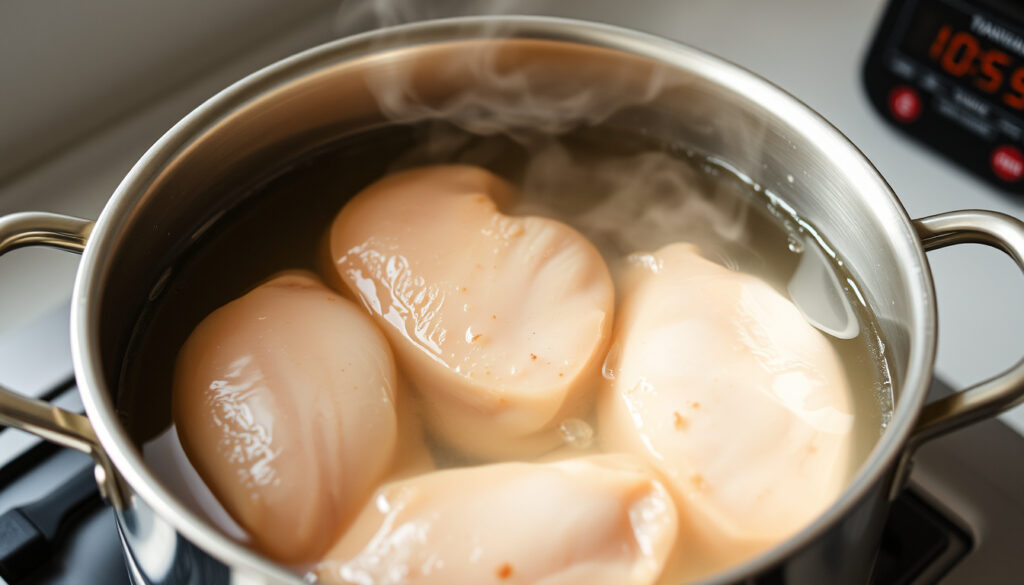
How Long to Boil Chicken Breast: Perfect Timing for Juicy Results
Boiling chicken breast sounds simple, but one extra minute can turn a tender piece into a dry, stringy disappointment. Whether you’re prepping for salads, shredding for tacos, or making a quick weeknight dinner, knowing the exact window of time — and the one temperature that guarantees safety — makes all the difference.
Safe internal temperature: 165°F (74°C) ·
Boneless, skinless breast (standard 6–8 oz): 10–15 min ·
Bone-in chicken breast: 20–25 min ·
Chicken tenders (thin cut): 6–8 min ·
Water ratio: Submerge fully, ~1 inch above chicken
Step-by-Step Guide to Boiling Chicken Breast
- Place the chicken breasts in a pot and cover with cold water by about 1 inch.
- Add salt and aromatics (garlic, bay leaf, peppercorns) to the water.
- Bring the water to a gentle simmer over medium heat, then reduce heat to maintain a steady simmer (small bubbles, not a rolling boil).
- Cook according to the cut: boneless breast 10–15 minutes, bone-in 20–25, tenders 6–8, etc.
- Use an instant-read thermometer to check the thickest part; remove when it reaches 165°F.
- Let the chicken rest for 5 minutes before slicing or shredding.
Quick snapshot
- USDA recommends 165°F internal temp for chicken (USDA food safety guidance)
- Boiling beyond 165°F dries out meat (Delish test kitchen)
- Exact minute ranges vary by breast size and starting temperature (Delish test kitchen) (Maple Jubilee cooking guide)
- Impact of different water-to-chicken ratios on total time (Maple Jubilee cooking guide)
- Cold water start yields more even cooking (Maple Jubilee cooking guide)
- Check internal temp after 10 min for boneless, 20 min for bone-in (Delish test kitchen)
- Rest 5 minutes before slicing; carryover heat adds a few degrees (Delish test kitchen)
Five key parameters cover the most common chicken cuts and cooking scenarios — here’s how the numbers stack up.
| Parameter | Value |
|---|---|
| Safe internal temperature | 165°F (74°C) |
| Average cooking time boneless breast (standard) | 10–15 minutes |
| Average cooking time bone-in breast | 20–25 minutes |
| Water temperature for simmer | Around 180–200°F (82–93°C) |
| Rest time after cooking | 5 minutes |
How long should you boil chicken breasts for?
The answer depends on the cut, thickness, and whether the bone is intact. Here are the ranges that consistently work.
Boneless skinless breast times (standard, thin-cut, large)
- Standard 6–8 oz breast: 10–15 minutes at a gentle simmer (Delish test kitchen)
- Thin cutlet (¼ inch): 6–8 minutes (Delish test kitchen)
- Large breast (10+ oz): 15–20 minutes; always verify with a thermometer
Bone-in breast timing
Bone-in breasts take longer because the bone conducts heat more slowly. Expect about 20–25 minutes for a standard bone-in breast (Food Network cooking guide). Check the thickest part near the bone with an instant-read thermometer.
How long to boil 2 chicken breasts?
Cooking two breasts at once barely changes the time if they are roughly the same size and fully submerged. Stick to the same per-breast range — but start checking at the lower end because the water temperature may dip slightly (Reddit cooking tips (community advice)).
How long to boil chicken tenders?
Thin strips (tenders) cook fast: 6–8 minutes. Check after 6 minutes — they often reach 165°F sooner than you expect (Delish test kitchen).
How long to boil chicken thighs?
- Boneless thighs: 15–20 minutes
- Bone-in thighs: 20–30 minutes (Food Network cooking guide)
The implication: different cuts require different windows, but the unifying rule is 165°F — not the clock alone.
Do I put chicken in water before or after it boils?
Cold water start vs. hot water start
Starting with cold water and bringing the pot to a gentle simmer produces more evenly cooked, tender chicken (Maple Jubilee cooking guide). Dropping raw chicken into already-boiling water can shock the meat and make it tough.
Should I boil water first then add chicken?
If you pre-boil the water and then add the chicken, reduce the heat to maintain a simmer — never a rolling boil. A vigorous boil will cause the outside to overcook before the inside reaches temperature (Delish test kitchen).
Can I put raw chicken into boiling water?
Technically yes, but it’s not the best technique. The sudden heat can cause the protein fibers to contract and expel moisture, resulting in drier meat. Most test kitchens recommend the cold-start method for juicier results (Food Network cooking guide).
Starting cold and simmering gently gives you a wider safety margin — even if you misjudge time by a minute or two, the breast stays at a safe, moist temperature rather than jumping past 165°F into dryness.
The pattern: starting cold yields a wider margin of error for busy cooks.
Can you overcook chicken by boiling it?
Signs of overcooked boiled chicken
- Dry, stringy texture that pulls apart easily
- Loss of flavor — the meat tastes bland and cottony
- Juices run clear but the meat feels tough
The USDA’s magic number is 165°F, and going beyond that accelerates moisture loss (CIDRAP summary of USDA guidelines).
How to prevent dry, stringy meat
- Set a timer for the lower end of the range (e.g., 10 minutes for standard boneless breast)
- Use an instant-read thermometer — remove chicken at 160–162°F; carryover heat will lift it to 165°F (USDA food safety advice)
- Let the chicken rest 5 minutes before slicing to redistribute juices
The trade-off: you can safely remove the chicken a degree or two below 165°F if you rely on carryover cooking — but never skip the thermometer check.
How to tell if boiled chicken breasts are done?
Using an instant-read thermometer
Insert the thermometer into the thickest part of the breast, avoiding the bone if present. The needle should read 165°F (Food Network cooking guide). This is the only truly reliable method — no guessing or timer-only approach matches its accuracy.
Visual and tactile cues (juices, color, firmness)
- Juices: When pierced, the liquid should run clear, not pink.
- Color: No pink in the center; the meat should be opaque throughout.
- Firmness: The chicken should feel firm but still give slightly under pressure — if it feels rigid, it’s likely overcooked (Delish test kitchen).
The pattern: visual cues help, but a thermometer is the only guarantee. Relying on “juices run clear” alone can be misleading, especially with older or darker meat.
What are common mistakes when boiling chicken?
Not seasoning the water
Chicken absorbs flavor from the cooking liquid. Without salt and aromatics (garlic, bay leaf, peppercorns), the meat will taste flat (Food Network cooking guide).
Boiling too vigorously
A rolling boil breaks down the connective tissue unevenly and forces moisture out. Keep the water at a gentle simmer (small bubbles, not violent agitation) (Maple Jubilee cooking guide).
Using too little water
The chicken must be fully submerged for even cooking. If the water level drops below the meat during cooking, parts will remain underdone or cook at different rates.
Skipping the rest period
Cutting into chicken immediately after cooking lets the juices run out onto the cutting board. Resting for 5 minutes lets the fibers reabsorb moisture, giving you a more succulent bite (Delish test kitchen).
Even if you avoid every mistake, a single overlooked variable — thickness, water volume, starting temperature — can shift cooking time by 3–5 minutes. That’s why the thermometer is non-negotiable.
The catch: even seasoned cooks can miss these details, but each one is fixable.
Confirmed facts vs. what remains unclear
The table below separates well-established guidelines from areas where timing remains variable.
| Confirmed facts | What’s unclear |
|---|---|
| USDA recommends 165°F internal temp for chicken (CIDRAP summary) | Exact minute ranges depend heavily on breast size, shape, and starting temperature |
| Boiling beyond 165°F dries out the meat (Delish test kitchen) | Influence of water-to-chicken ratio on cooking time is not precisely documented |
| Cold water start yields more even cooking (Maple Jubilee cooking guide) | No large-scale study comparing hot-start vs. cold-start juiciness in home settings |
“The safest way to ensure your chicken is ready is to use an instant-read thermometer. No timer can account for every variable.”
“Simmering, not boiling, gives you tender, not tough, meat. Once you see a gentle roll, turn the heat down and let it cook.”
“Poultry is safe when cooked to 165°F. Using a food thermometer is the only way to know.”
For anyone who cooks chicken regularly, the difference between a dry, stringy breast and a tender, moist one is just a few minutes on the clock — and one check with a thermometer. Master that, and you’ve unlocked a reliable, healthy protein for salads, shredding, soups, or quick dinners. For home cooks juggling multiple tasks, the rule is simple: 165°F, not a second more.
Related reading: How to Boil Chicken · How To Boil Chicken
wisconsinrivermeats.com, reddit.com, springermountainfarms.com, facebook.com, chefiq.com, youtube.com
Frequently asked questions
Can I boil frozen chicken breast?
Yes, but it will take about 50% longer than thawed chicken. Simmer until the thickest part reaches 165°F. The USDA advises that frozen chicken can be cooked directly without thawing (Food Network cooking guide).
How long to boil chicken breast for salad?
For salads, boneless skinless breasts take 10–15 minutes. Cook until 165°F, cool, then slice or shred. The shorter cooking time helps maintain a firm texture that holds up to dressing.
Should I cover the pot when boiling chicken?
Yes, covering the pot helps maintain a steady simmer and reduces evaporation. Leave the lid slightly ajar to prevent boiling over.
Do I need to add salt to the water?
Absolutely. Salt seasons the chicken from the inside out. A tablespoon of kosher salt per quart of water is a good starting point (Food Network cooking guide).
How to store boiled chicken breast?
Let it cool to room temperature, then refrigerate in a sealed container for up to 4 days. For longer storage, freeze in a vacuum-sealed bag for 2–3 months.
Can I use the leftover water (broth) for soup?
Yes, the poaching liquid is a flavorful foundation for soups or sauces. Strain it through a fine-mesh sieve and use within 3 days, or freeze for later.
Can I boil chicken breast in milk or broth instead of water?
Yes, using broth adds flavor, and milk (or buttermilk) can tenderize. Simmer at the same temperatures; the fat in milk may help keep the meat moist.
More related posts
 Things to Do in Malta: Attractions, Budget & Tips 2026
 Sweaty Betty Swiftie Running Cap: Worth the Price
 Live Traffic Update Dublin – Real-Time Maps, M50 and Delays
 How to Take a Screenshot on Samsung Galaxy (6 Ways)
 Bleeding from Back Passage: Causes, Color Guide & When to Worry
 Can Dogs Eat Onions? Toxicity Risks, Symptoms Explained
 Mountaineers of Iceland Snowmobiling: Tours, Prices & Tips
 CRH Share Price London Today: Stock Forecast & Analysis