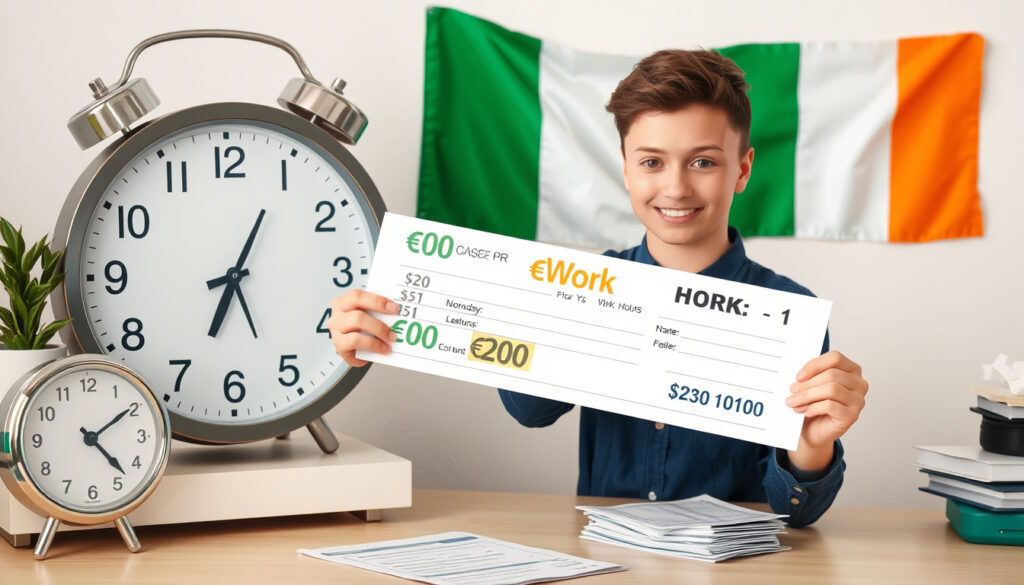
Minimum Wage for 16 Year Old Ireland 2026: Rates, Hours & Tax
The 2026 minimum wage for a 16-year-old in Ireland is €9.91 per hour, but strict hour limits and tax thresholds mean most teenagers take home every euro they earn.
National minimum wage (age 20+): €14.15 per hour (from 1 Jan 2026) ·
Sub-minimum rate for under 18: €9.91 per hour (70% of NMW) ·
Rate for 18 year olds: €11.32 per hour (80% of NMW) ·
Maximum weekly hours for 16 year old: 8 hours on school days / 40 hours during breaks
Quick snapshot
- Under‑18 minimum wage: €9.91/hour (Workplace Relations Commission – Ireland’s labour regulator)
- Max working hours: 8 hours/day during term, 40 hours/week during holidays (WRC guidance on young persons)
- Night work banned between 8 p.m. and 8 a.m. (Citizens Information – official public service)
- 30‑minute break after 4.5 hours of work (SpunOut.ie – youth information charity)
- Whether the 2027 under‑18 rate will follow the same 70% formula (Low Pay Commission – independent rate‑setting body)
- Exact net earnings for a 16‑year‑old with variable weekly schedules (Revenue – Irish tax authority)
- How compliance rates for under-18 minimum wage will evolve (WRC employer obligations page)
- 2022: under‑18 rate €8.73/hour (Employsome – Irish payroll specialists)
- 2023: rate increased to €9.31/hour (Government press statement (gov.ie))
- January 2026: rate reached €9.91/hour (Citizens Information – rights of young workers)
- Reviews happen annually; next update 2027 (Low Pay Commission publications)
- Low Pay Commission to recommend 2027 rates in late 2026 (Low Pay Commission)
- Employers must keep records of young workers’ hours and pay (Protection of Young Persons Act 1996 – Irish Statute Book)
Ireland’s age‑tiered minimum wage creates four distinct pay bands in 2026. Each applies to all employees covered by the National Minimum Wage Act 2000, regardless of full‑time or part‑time status (Workplace Relations Commission (WRC)).
| Label | Value |
|---|---|
| Current rate (under 18) | €9.91 per hour (since 1 Jan 2026) |
| Previous rate (2025) | €9.74 per hour |
| Increase amount | +€0.17 per hour |
| Rate for 18‑year‑olds | €11.32 per hour |
| Rate for 19‑year‑olds | €12.74 per hour |
| Rate for 20+ | €14.15 per hour |
| Effective date | 1 January 2026 |
| Legal source | Workplace Relations Commission / Citizens Information |
What is the minimum wage for a 16 year old in Ireland?
Three age bands create the pay structure. A 16‑year‑old falls into the “under 18” category and earns 70% of the adult rate.
Four age‑based rates, one pattern: the younger the worker, the bigger the percentage gap from the adult wage.
| Age | Hourly rate (from 1 Jan 2026) | % of adult min wage |
|---|---|---|
| Under 18 | €9.91 | 70% |
| 18 years | €11.32 | 80% |
| 19 years | €12.74 | 90% |
| 20 years and over | €14.15 | 100% |
Source: Workplace Relations Commission (official regulator) – 2026 NMW table
Difference between NMW and sub‑minimum rates
- The full national minimum wage (€14.15) applies only from age 20 onward.
- Under‑18 workers receive a “sub‑minimum” – a fixed percentage of the adult rate.
- These percentages have stayed the same since the system was introduced: 70%, 80%, 90%.
- Employers cannot pay less than the statutory sub‑minimum for the age band (WRC – National Minimum Wage Act 2000).
The implication: a 16‑year‑old working 15 hours a week at €9.91 earns about €148.65 gross per week – nearly €64 less than an adult working the same hours. That gap reflects the law’s intent to protect education first.
How many hours can a 16 year old legally work in Ireland?
Hours are strictly capped by the Protection of Young Persons (Employment) Act. The rules split between term time and school holidays.
Two sets of limits, one goal: keep school and rest before earnings.
| Period | Maximum per day | Maximum per week |
|---|---|---|
| School term (ages 16–17) | 8 hours | 40 hours |
| School holidays (ages 16–17) | 8 hours | 40 hours |
| School term (age 15) | 8 hours (but max 8h/week overall) | 8 hours |
| School holidays (age 15) | 8 hours | 35 hours |
Sources: Workplace Relations Commission – Employment of Young Persons · SpunOut.ie (youth information charity)
Rest periods and night work restrictions
- 16‑year‑olds must get a 30‑minute break after 4.5 hours of work.
- They are entitled to at least 21 hours of consecutive rest per week.
- Work is strictly forbidden between 8 p.m. and 8 a.m.
- No overtime or night shifts allowed for under‑18s (Citizens Information – rights of young workers).
A 16‑year‑old working 20 hours per week during term (the max allowed on school days) earns about €198.20 gross – below the threshold for USC or PRSI in most cases. But even one breach of the 8‑p.m. curfew could trigger an inspection from the WRC.
Is the minimum wage for under 18 going up in 2026?
Yes. The under‑18 rate increased by €0.17 from €9.74 to €9.91 on 1 January 2026 – a 1.7% rise.
Three years of increases show a steady upward trend.
| Year | Under‑18 rate | Increase from previous |
|---|---|---|
| 2022 | €8.73 | – |
| 2023 | €9.31 | +€0.58 (+6.6%) |
| January 2026 | €9.91 | +€0.60 (+6.4% from 2023) / +€0.17 from 2025 |
Source: Employsome (Irish payroll specialists) · Government press statement (gov.ie)
The trade‑off: while the adult rate rose more in absolute terms, the sub‑minimum percentage (70%) has not changed since 2022. The Low Pay Commission’s annual review will decide whether 2027 brings a percentage shift or an inflation‑linked bump.
Do 16 year olds pay tax on their earnings in Ireland?
Most 16‑year‑olds working part‑time will not owe tax – but the thresholds are lower than many assume.
Three tax layers, one practical outcome: the vast majority of teenage earners pay zero direct tax.
| Tax type | Threshold | Applies to a 16‑year‑old? |
|---|---|---|
| PAYE (income tax) | Income over €18,000 per year | Only if annual earnings exceed this – unlikely for part‑time |
| Universal Social Charge (USC) | Earnings above €13,000 per year | Rare for under‑18s; 16 hours/week at €9.91 = ~€8,240/year |
| PRSI (social insurance) | Weekly earnings above €352 | Very rare – would require 35.5 hours/week at €9.91 |
Source: Revenue (Irish tax authority) – tax and USC thresholds
If a 16‑year‑old does earn above the PAYE or USC thresholds, the employer deducts tax at source. They must also have a PPS number and register with Revenue if earning more than €15,700 per year (Citizens Information – young workers tax).
The implication: a 16‑year‑old working 10 hours per week earns around €5,150 annually – well below every threshold. Tax only becomes real for those working near the legal maximum of 40 hours during holidays.
What are the employment rights for a 16 year old worker in Ireland?
The Protection of Young Persons (Employment) Act 1996 is the backbone of young workers’ rights. It covers rest breaks, prohibited work, and written contracts.
- 30‑minute break after 4.5 hours of continuous work.
- 21 consecutive hours of rest per week – usually a full day off.
- Prohibited occupations: work involving hazardous machinery, night‑club serving, or any role that poses a risk to health or education (WRC – prohibited occupations).
- Written terms of employment must be given within the first month of starting.
- Employer records: hours worked, wages paid, and breaks must be logged and kept for 3 years.
Source: Workplace Relations Commission – young persons employment
If an employer pays less than €9.91/hour or makes a 16‑year‑old work past 8 p.m., the WRC can order back pay and impose fines up to €2,500 per breach. The onus is on the employer to prove compliance.
The pattern: Ireland’s youth‑employment laws treat education as the priority. The 8‑hour daily cap, the night‑work ban, and the rest requirements are not negotiable – and they apply regardless of the industry.
Steps to verify your pay as a 16‑year‑old worker
- Check your payslip for the hourly rate: it must be at least €9.91.
- Count your total weekly hours – they cannot exceed 40 during holidays or 8 per day during term.
- Ensure you have a written statement of terms from your employer within one month.
- Keep a log of your daily start and finish times to compare with legal rest rules.
- If you suspect a breach, contact the Workplace Relations Commission for advice.
“The protection of young persons at work is a key priority. The new national minimum wage rates from January 2026 reflect the Government’s commitment to fair pay while supporting young people’s education and development.”
– Department of Employment Affairs and Social Protection, official press statement (gov.ie)
“A 16‑year‑old working part‑time should not have to worry about complex tax deductions. Our guide breaks it down – most will pay zero tax, but it’s crucial to understand the thresholds.”
– Citizens Information, Rights of Young Workers guide
Related reading
- Foreign Birth Registration Ireland: Eligibility & Process
- Who Is Exempt from Property Tax in Ireland? 2026-2030 LPT Exemption
For a 16‑year‑old in Ireland, the 2026 minimum wage of €9.91 is not just a number – it’s embedded in a legal framework that caps hours, bans night work, and exempts most teenagers from tax. The choice for a young worker is clear: understand the rules, track your hours, and know that the WRC has your back. Employers face real penalties for non‑compliance, so the cost of paying below the sub‑minimum rate far outweighs any short‑term saving.
purpletree.ie, esri.ie, fssu.ie, spunout.ie, econstor.eu, ibec.ie, employsome.com, mrci.ie, retailexcellence.ie, ictu.ie
Frequently asked questions
What is the minimum wage for a 17 year old in Ireland?
The same as for a 16‑year‑old: €9.91 per hour (under‑18 band). The rate does not change until the employee turns 18.
Can a 16 year old work full time in Ireland during summer?
Yes, but only up to 40 hours per week. The daily cap of 8 hours also applies, so a “full‑time” week would be five 8‑hour days.
Does a 16 year old need a work permit in Ireland?
No. Irish citizens, EU/EEA nationals, and most residents with existing immigration permission do not need a separate work permit for part‑time or holiday work.
Are 16 year olds entitled to holiday pay in Ireland?
Yes. All workers, regardless of age, are entitled to holiday pay equivalent to 8% of gross earnings under the Organisation of Working Time Act.
What happens if an employer pays below the minimum wage for a 16 year old?
The employee (or a parent) can file a complaint with the Workplace Relations Commission. The employer can be ordered to pay back wages and fined up to €2,500 per breach.
Can a 16 year old work in a pub or restaurant in Ireland?
Yes, but only if the work does not involve serving alcohol or working after 8 p.m. Pubs and restaurants must also comply with the 8‑hour daily limit and break requirements.
Does a 16 year old have to register with Revenue?
Only if annual earnings exceed €15,700 (PAYE threshold) or if they are liable for USC. Most part‑time teenagers do not need to register.
What is the minimum wage for a 15 year old in Ireland?
The under‑18 rate of €9.91/hour also applies to 15‑year‑olds, but the hour limits are stricter: max 8 hours per week during term time, and 35 hours during holidays.
More related posts
 Connacht vs Munster Tickets 2026: Prices, TV Coverage
 AZ Alkmaar vs Shelbourne (2-0): Match Recap & Analysis
 Eli Lilly Share Price: LLY Quote, Chart & Forecast
 Next Castlebar Opening Hours: Lannagh Road Retail Park
 Pulpo a la Gallega Recipe – How to Cook Galician Octopus
 Ronan Day-Lewis: Biography, Age, Movies, Paintings & Facts
 How to Prepare for an Interview: Complete Guide & Tips
 Have I Been Pwned? Your Guide to Checking Email Breaches Safely