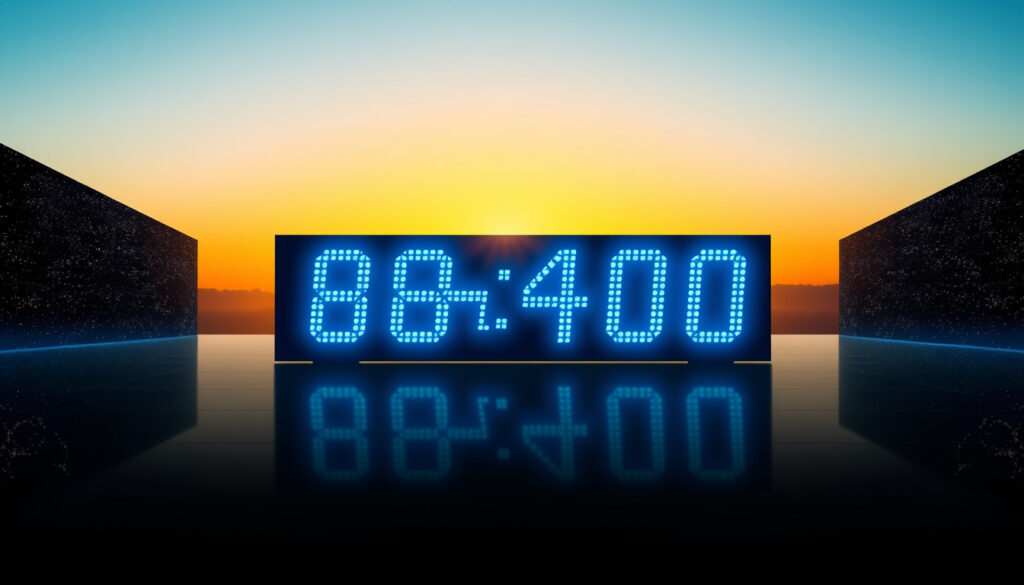
How Many Seconds Are in a Day? 86,400 Seconds Explained
It’s one of those questions that feels almost too simple to ask — and yet the answer carries more nuance than most people expect, whether you’re a student tackling time conversions or a developer working with timestamps. Knowing precisely how many seconds fill a day, a year, or a billion years can change how you think about time itself.
Seconds in a day: 86,400 ·
Seconds in an hour: 3,600 ·
Seconds in a week: 604,800 ·
Seconds in a year (365 days): 31,536,000 ·
One million seconds: ≈ 11.57 days ·
One billion seconds: ≈ 31.7 years
Quick snapshot
- 86,400 seconds in a standard civil day (NIST Time and Frequency Division)
- 1 million seconds ≈ 11.57 days (timeanddate.com)
- 1 billion seconds ≈ 31.7 years (timeanddate.com)
- Exact seconds in a month (varies by month length)
- Whether a given civil day includes a leap second
- Total seconds in a year after calendar drift corrections
- Whether the solar day or sidereal day is being referenced
- The exact year length accounting for the Gregorian 400‑year cycle average
- Leap seconds are inserted to keep civil time within 0.9 seconds of Earth rotation (NIST Leap Seconds FAQ)
- Earth’s rotation is gradually slowing, lengthening the day by ~2 ms per century (NASA ADS – Stephenson talk)
- Convert seconds to minutes, hours, days, and years using simple formulas
- Compare million, billion, trillion, and quintillion seconds side by side
The conversion table below lays out the standard time unit relationships.
| Unit | Seconds | Source |
|---|---|---|
| Second | 1 | BIPM SI base units |
| Minute | 60 | Calculated from standard conversion (Encyclopaedia Britannica) |
| Hour | 3,600 | |
| Day | 86,400 | |
| Week | 604,800 | |
| 30‑day month | 2,592,000 | |
| 31‑day month | 2,678,400 | |
| Common year (365 d) | 31,536,000 | timeanddate.com |
| Leap year (366 d) | 31,622,400 | timeanddate.com |
The implication: these conversions assume an exact 86,400‑second day, which holds for nearly all practical purposes.
How many seconds are in a 24 hour day?
The answer is a tidy 86,400 — but only when you’re using the standard civil day. That number comes from multiplying 24 hours by 60 minutes by 60 seconds. The BIPM (International Bureau of Weights and Measures) defines the SI second as the base unit of time, and the day is an accepted non‑SI unit equal to exactly 86,400 of those seconds.
How many seconds are in an hour?
- 1 hour = 60 minutes × 60 seconds = 3,600 seconds (Encyclopaedia Britannica)
How many seconds are in a minute?
- 1 minute = 60 seconds — a fixed conversion across all time systems.
Why does a day have 86,400 seconds?
- Historically, the second was defined as 1/86,400 of a mean solar day. Today it’s atomic, but the civil day is still treated as 86,400 s for most purposes.
- On rare occasions a leap second is added (or subtracted), making that day 86,401 or 86,399 seconds long. The NIST Leap Seconds FAQ explains that 27 leap seconds have been added since 1972.
Earth’s rotation doesn’t keep perfect pace with the atomic clock. Tidal friction slows the planet by about 2 ms per century (NASA ADS – Stephenson talk), so over long timescales the “86,400‑second day” is a convenient convention, not a law of nature.
Bottom line: For everyday use, a day is 86,400 seconds. But if you’re working with high‑precision timing or centuries‑long intervals, expect occasional adjustments.
How many seconds are in a year?
One year of 365 days holds 31,536,000 seconds. The extra day in a leap year pushes that to 31,622,400 seconds. The Gregorian calendar averages 365.2425 days (31,556,952 seconds) across a 400‑year cycle.
How many seconds in a common year (365 days)?
- 365 × 86,400 = 31,536,000 seconds – confirmed by timeanddate.com
How many seconds in a leap year (366 days)?
- 366 × 86,400 = 31,622,400 seconds – also from timeanddate.com
How many seconds in a decade? century?
- Decade (10 common years): 315,360,000 seconds
- Century (100 common years): 3,153,600,000 seconds
- But because of leap years, the actual total varies. The Gregorian average gives 31,556,952 s per year.
Bottom line: A year contains around 31.5 million seconds. The difference between a common and a leap year is just 86,400 seconds — one whole day.
Is 7200 seconds 2 hours?
Yes — 7,200 seconds equals exactly 2 hours. The math is straightforward: 2 hours × 3,600 seconds/hour = 7,200 seconds. This conversion works in reverse too: dividing seconds by 3,600 gives hours.
How many seconds in an hour?
- 1 hour = 3,600 seconds (60 min × 60 s).
How to convert hours to seconds
- Multiply hours by 3,600. Example: 5 h × 3,600 = 18,000 s.
How to convert seconds to hours
- Divide seconds by 3,600. Example: 10,800 s ÷ 3,600 = 3 h.
If you’re tracking billable hours or workout intervals, remembering that 3,600 s = 1 h keeps you from mis‑reading a timer. The same logic scales: 86,400 s = 1 day, 2,592,000 s ≈ 30 days.
How long is 1,000,000,000,000 seconds?
One trillion seconds is about 31,700 years — a span that dwarfs recorded human history. To get a feel for these enormous numbers, compare them side by side.
Three orders of magnitude, three vastly different experiences of time:
| Unit | Seconds | Duration in days / years | Source |
|---|---|---|---|
| 1 million seconds | 1,000,000 | ≈ 11.57 days | timeanddate.com |
| 1 billion seconds | 1,000,000,000 | ≈ 31.7 years | timeanddate.com |
| 1 trillion seconds | 1,000,000,000,000 | ≈ 31,700 years | timeanddate.com |
How long is 1 million seconds?
- 11.57 days — about the time between two weekends.
How long is 1 billion seconds?
- 31.7 years — enough to go from birth to mid‑career.
Is 1 trillion seconds 31 years?
- No, that’s a common confusion. 1 trillion seconds is 31,700 years — about 1,000 times longer than 1 billion seconds.
Bottom line: Our intuition breaks past the million mark. A trillion seconds ago, humans were still in the Stone Age.
How long is 1 quintillion seconds?
One quintillion seconds (1,000,000,000,000,000,000) equates to roughly 31.7 billion years — more than twice the estimated age of the universe (13.8 billion years). This number is so large it’s hard to anchor in anything familiar.
How many years is 1 quintillion seconds?
- 1 quintillion seconds ÷ 31,536,000 s/year ≈ 31.7 billion years.
How long is 1 sextillion seconds?
- 1 sextillion = 1,000 quintillion = ~31.7 trillion years — unfathomably longer than any cosmic timescale.
Putting huge numbers in perspective
- 1 million seconds: 11.5 days – a vacation.
- 1 billion seconds: 31.7 years – a generation.
- 1 trillion seconds: 31,700 years – since the last ice age.
- 1 quintillion seconds: 31.7 billion years – more than twice the age of the universe.
Using large numbers like quintillions in everyday conversation is impractical — the human brain just doesn’t perceive those scales. But for astronomers and particle physicists, these numbers are routine. The gap between intuition and reality is millions of times bigger than most of us realize.
How to convert seconds to days, hours, and minutes
A simple process works for any amount of seconds:
- Step 1: Divide seconds by 3,600 to get hours. (1 h = 3,600 s)
- Step 2: Take any remainder and divide by 60 to get minutes. The leftover is seconds.
- Step 3: For larger units, divide total seconds by 86,400 for days, or by 604,800 for weeks.
Example: 100,000 seconds ÷ 3,600 = 27.78 h → 27 h + 0.78 h → 27 h + 46.8 min → 27 h, 46 min, 48 s. Approx: 1 day, 3 h, 46 min.
What we know and what remains uncertain
Confirmed facts
- 86,400 SI seconds in a standard day (NIST)
- 1 million seconds = 11.574 days
- 1 billion seconds = 31.7 years
- 1 trillion seconds = 31,700 years
- Conversion formulas (seconds = hours × 3,600, etc.)
What’s unclear
- Exact seconds in a month (29 to 31 days)
- Whether a given day includes a leap second
- Precise annual total accounting for calendar drift
- Whether solar day or sidereal day is intended
- The Gregorian 400‑year cycle average of 31,556,952 seconds remains an approximation
Expert perspectives on large time scales
Although typically 86,400 SI seconds in duration, a civil day can be either 86,401 or 86,399 SI seconds long on such a day.
One billion seconds is about 31.7 years.
The numbers don’t lie — but they do challenge our intuition. A million seconds feels like a long wait; a billion seconds is a career; a trillion seconds predates civilization. For anyone who regularly converts time or works with large datasets, understanding these scales is more than trivia — it’s a safeguard against misinterpretation. The next time someone asks “how many seconds are in a day?”, you can answer 86,400 — and then explain why that number is both rock‑solid and slightly negotiable.
For a detailed breakdown of the math, see the exact calculation of seconds in a day from CityPost Daily.
Frequently asked questions
How many minutes are in a day?
1 day = 24 hours × 60 minutes = 1,440 minutes.
How many seconds are in a week?
7 days × 86,400 seconds/day = 604,800 seconds.
How many seconds are in a month?
It depends on the month: 30 days = 2,592,000 seconds; 31 days = 2,678,400 seconds; February has 2,419,200 seconds in a common year or 2,505,600 in a leap year.
How many seconds are in 2 days?
2 days = 2 × 86,400 = 172,800 seconds.
How long is 777 minutes?
777 minutes ÷ 60 = 12.95 hours = 12 hours and 57 minutes.
How many years is 1 quintillion seconds?
1 quintillion seconds ≈ 31.7 billion years – more than twice the age of the universe.
Is 1000000000 seconds 32 years?
Very close: 1 billion seconds ≈ 31.7 years. 32 years would be about 1.01 billion seconds.
Related reading
More related posts
 Come organizzare il tempo: 1-3-5, ALPEN & Rule of 3
 Eli Lilly Share Price: LLY Quote, Chart & Forecast
 Homestore and More Blanchardstown: Hours, Deals & Info
 Ronan Day-Lewis: Biography, Age, Movies, Paintings & Facts
 Porsche 911 GT3 RS: Price, Specs & Real Costs
 RIP Death Notices Dublin: Guide to Finding and Searching
 High Calcium Levels in Blood: Causes, Symptoms, and Treatment