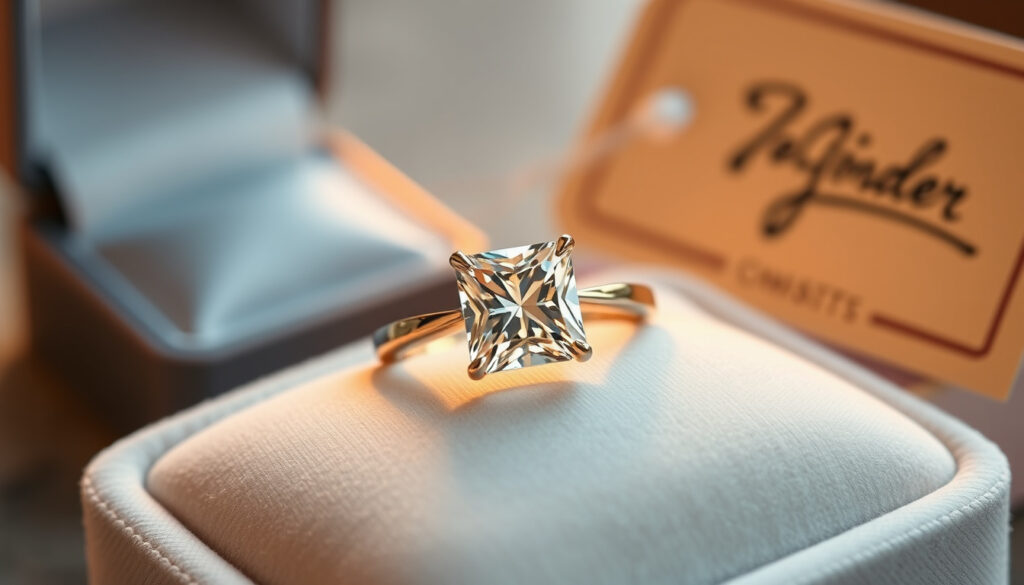
Princess Cut Engagement Ring: Cost, Meaning & Buying Guide
Choosing between a princess cut and a round diamond often comes down to a trade-off: maximum sparkle or maximum value. For Irish buyers, that trade-off carries real numbers. Princess cuts typically cost 20–30% less per carat than rounds of the same quality, according to DiamondsByUK (jeweller analysis). With the average engagement ring in Ireland hitting €3,840 in 2025, that difference can mean upgrading a whole carat or staying comfortably under budget.
Average engagement ring price in Ireland (2025): €3,840 ·
Princess cut vs round price difference: ~20–30% less per carat ·
Average carat weight in Ireland: 2.22 ct overall
Quick snapshot
- Square modified brilliant cut with 50–58 facets (Angara (jeweller))
- Sharp corners and strong sparkle define its modern look (Angara (jeweller))
- Second most popular diamond cut globally, after round brilliant (Angara (jeweller))
- More affordable per carat than round (Whiteflash (diamond retailer))
- Higher risk of chipping at corners due to sharp points (Whiteflash (diamond retailer))
- Less brilliance but more fire than round (Brilliance Blog (education))
- Traditional rule of thumb: 2–3 months of salary (Bespoke Diamonds IE (market data))
- Average spend in Ireland: €3,840 overall (Bespoke Diamonds IE (market data))
- 2 ct considered large and eye‑catching (Bespoke Diamonds IE (market data))
- Taylor Swift’s emerald cut ring boosted geometric cuts
- Princess cut remains a celebrity favourite for clean lines
- Celebrity choices drive demand for square shapes
| Metric | Value | Source |
|---|---|---|
| Average engagement ring price (Ireland, 2025) | €3,840 | Bespoke Diamonds IE |
| Average price lab‑grown round (1 ct) | ≈ £5,690 | DiamondsByUK |
| Average price lab‑grown princess (1 ct) | ≈ £4,240 | DiamondsByUK |
| Cutting waste – round brilliant | ~60% | DiamondsByUK |
| Cutting waste – princess cut | ~20% (80% retained) | DiamondsByUK |
| Average natural diamond ring price (Ireland) | €6,800 | Bespoke Diamonds IE |
What does a princess cut engagement ring mean?
A princess cut is a square or rectangular modified brilliant cut, typically featuring 50–58 facets. Its sharp corners and strong sparkle give it a modern, geometric look that sets it apart from the classic round brilliant. According to Angara (jeweller guide), the cut maximizes brilliance while offering a distinct shape that works well in solitaire and halo settings.
The cut was invented in 1980 by diamond cutter Betzalel Ambar, and it quickly grew to become the second most popular engagement ring cut worldwide. Its lower price point compared to rounds — generally 20–30% less per carat — makes it a go‑to choice for buyers who want a large diamond without blowing their budget.
The princess cut offers a bold, square silhouette and strong fire at a price that undercuts round diamonds by a significant margin — but its sharp corners demand a protective setting, like a V‑prong or bezel, to prevent chipping.
Is princess cut better than round?
Why not buy a princess cut diamond?
- Brilliance: Round brilliant diamonds still produce more white light return. Brilliance Blog notes princess cuts excel in fire (coloured flashes) rather than pure brilliance.
- Durability: The pointed corners of a princess cut are more vulnerable to chipping if struck. Many jewellers recommend a bezel or V‑prong setting for protection.
- Price: For an identical carat weight, colour and clarity grade, a princess cut costs roughly 20–30% less. A concrete example from Brian Gavin Diamonds: a 1.045 ct G‑VS1 ideal‑cut princess was $6,066 vs $9,281 for a round.
- Visible size: Because princess cuts retain more rough diamond weight, they often look smaller face‑up than a round of the same carat — the same 1.045 ct diamond measures 5.46×5.41 mm versus 6.52×6.54 mm for the round.
The trade‑off is clear: you sacrifice some brilliance and face‑up size but gain substantial cost savings and a contemporary aesthetic. For many Irish buyers, that’s a winning exchange.
How much should I spend on an engagement ring if I make $100,000 a year?
What is a poor man’s diamond?
The traditional rule of thumb — 2–3 months of salary — would suggest a budget of $16,000–$25,000 for a $100,000 income. However, actual spending varies enormously. In Ireland, the average engagement ring price in 2025 is €3,840, according to Bespoke Diamonds IE (market research), with lab‑grown diamonds averaging €3,100 and natural diamonds €6,800. A 2‑carat ring is considered large and eye‑catching — the Irish average is 2.22 ct overall.
Is a 2 carat ring considered big?
Yes, a 2 ct diamond sits well above the average and will be noticeable. For a $100,000 earner, a quality 2 ct princess cut could cost $6,000–$15,000 depending on lab‑grown vs natural, leaving plenty of room in the budget for a custom setting.
The phrase “poor man’s diamond” usually refers to cubic zirconia or moissanite, which mimic diamond sparkle at a fraction of the price. These alternatives are popular among budget‑conscious buyers.
Spending guidelines are just that — guidelines. The real cost of a princess cut engagement ring in Ireland is often lower than traditional formulas suggest, especially when you choose lab‑grown diamonds or a princess cut over round.
What cut is Taylor Swift’s engagement ring?
Taylor Swift’s engagement ring from Travis Kelce features an emerald cut diamond, designed by jeweller Neil Lane. The emerald cut — a rectangular step cut with a large, open table — has a distinctly geometric look that aligns with the modern aesthetic of princess cuts. Celebrity choices like this one have helped fuel demand for square, linear diamond shapes.
For shoppers browsing Irish jeweller catalogues, the princess cut remains a popular alternative to the emerald cut: both offer clean lines, but the princess cut delivers more sparkle due to its brilliant‑style faceting.
How soon after getting engaged do you marry?
The average engagement period in Ireland and the UK falls between 12 and 18 months. This timeline allows for venue booking, dress selection, and wedding planning without feeling rushed. Some couples marry within weeks; others stretch the engagement to three or more years. The key is aligning the timeline with your budget and wedding vision.
Once the ring is chosen — say, a princess cut solitaire from an Irish retailer — many couples immediately start negotiating photographer and venue dates. The ring itself doesn’t dictate the length of the engagement, but a striking diamond often sparks the conversation.
Confirmed facts vs. open questions
Confirmed facts
- Princess cut is a square modified brilliant cut with 50–58 facets (Angara)
- Princess cuts cost 20–30% less than equivalent rounds (DiamondsByUK)
- Average engagement ring price in Ireland in 2025 is €3,840 (Bespoke Diamonds IE)
- Round brilliant is the most popular cut; princess ranks second
- Taylor Swift’s engagement ring is an emerald cut
What’s unclear
- Whether princess cut diamonds are significantly more prone to chipping than other sharp‑corner cuts (e.g., cushion, radiant)
- The optimal prong setting for princess cut diamonds — V‑prong vs. bezel vs. claw — is debated among jewellers
- Exact long‑term price trends for lab‑grown princess cuts vs. natural rounds in the Irish market
Expert perspectives
“The princess cut diamond is a square brilliant cut that offers a modern, geometric look. Its sharp corners and strong sparkle make it a bold choice for those seeking something different.”
— Angara (jeweller guide)
“Princess cut diamonds are typically more affordable carat‑for‑carat than round brilliant diamonds, making them an excellent option for budget‑conscious buyers.”
“The princess cut’s modern sparkle and bold shape have made it a popular choice for those who want a contemporary twist on the classic solitaire.”
Three different industry voices all converge on the same take: the princess cut is a value‑packed, fashionable alternative to the round brilliant. The catch is that its sharp corners require careful setting work.
For Irish couples, the decision is straightforward: if you prioritise maximum brilliance and a classic round shape, go for the round brilliant. If you want a larger diamond, a modern aesthetic, and a noticeably lower price — and you’re willing to protect the corners with the right setting — the princess cut is the smarter choice. For the majority of buyers browsing Dublin or Cork jewellers, that trade‑off makes the princess cut the winner on value per carat.
For a more detailed breakdown of settings and value retention, see our comprehensive princess cut engagement ring guide.
Frequently asked questions
What is the best prong setting for a princess cut diamond?
A V‑prong or a bezel setting is recommended to protect the sharp corners from chipping. Many Irish jewellers offer both options, with the V‑prong being the most popular for solitaire rings.
Can a princess cut diamond be re‑cut into a round?
Technically yes, but it would lose a significant amount of carat weight and is rarely cost‑effective. Most buyers choose to keep the shape or trade the stone.
How to clean a princess cut engagement ring?
Soak in warm water with mild dish soap for 20 minutes, then gently brush with a soft toothbrush. Rinse and dry. Avoid ultrasonic cleaners if the diamond has visible inclusions or the setting is delicate.
Is princess cut suitable for a three‑stone ring?
Absolutely. The square shape pairs well with round or tapered baguette side stones. It’s a popular design in Irish jeweller catalogues.
What is the difference between princess cut and cushion cut?
Princess cut is square with sharp corners and brilliant faceting; cushion cut is square or rectangular with rounded corners and a softer, “pillow‑like” appearance. Cushion cuts tend to have larger facets and a more romantic, vintage feel.
How to tell if a princess cut diamond is well‑cut?
Look for an official grading report (e.g., GIA, IGI) that notes cut grade. A well‑cut princess cut has crisp corners, symmetrical faceting, and no windowing (a see‑through effect).
What is the typical carat weight for a princess cut engagement ring?
In Ireland, the average carat weight across all engagement rings is 2.22 ct. For princess cuts specifically, popular sizes range from 1 ct to 2 ct, balancing visible presence with cost.
Related reading: Princess Cut vs Round Cut: Price Comparison & Buying Guide · Princess Cut Engagement Ring Buying Guide
More related posts
 Have I Been Pwned? Is It Safe? Trust & Privacy Explained
 The Times and Sunday Times – Differences, Ownership, History
 Canker Sore on Tongue: Causes, Fast Relief & What Mimics It
 5ft 5 in cm: Exact Conversion & Practical Guide
 How to Get Rid of a Headache Fast: NHS Tips
 One Battle After Another Reviews: Critics, Box Office & Spielberg
 Why Transparency and Lab Testing Matter to Today’s CBD Consumers