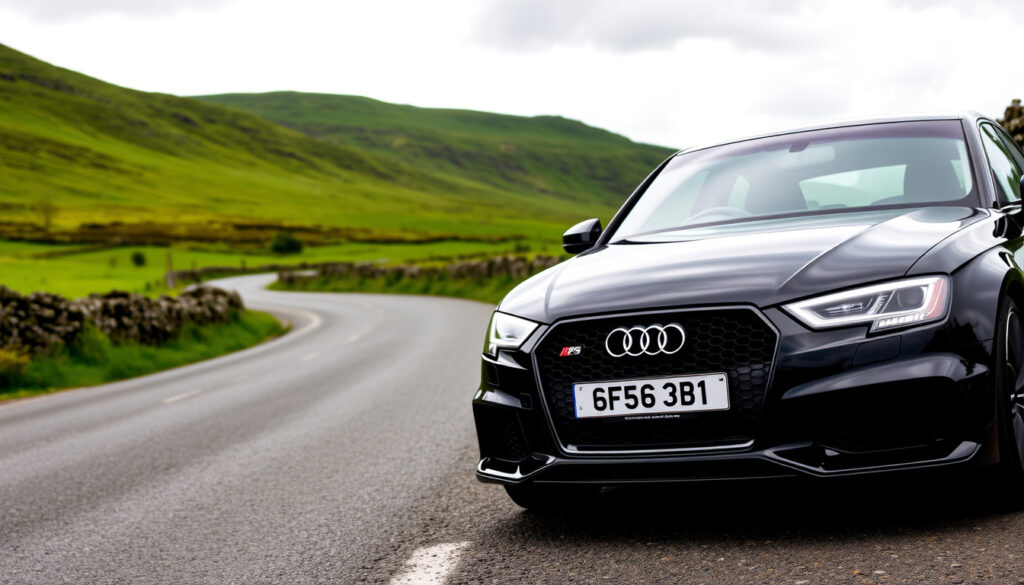
Audi RS3 for Sale Ireland: Price & Specs Guide
There’s a reason the Audi RS3 has a devoted following among Irish performance car buyers: it packs genuine supercar-slaying pace into a hatchback you can park on any Dublin street. With a 400-horsepower five-cylinder engine and a 0-100 km/h time of 3.8 seconds, it’s a car that makes every commute feel like a track day.
0-100 km/h: 3.8 seconds · Engine: 2.5L TFSI 5-cylinder · Power: 400 hp · Price in Ireland (used example): from €59,499 · Top speed: 280 km/h (electronically limited)
Quick snapshot
- 0-100 km/h in 3.8 seconds (Carwow (UK car comparison site))
- 2.5L turbo 5-cylinder engine with 400 hp (Joe Duffy Audi (official Audi dealer Ireland))
- Available in Sportback and Saloon body styles (Joe Duffy Audi)
- Exact number of RS3 units currently for sale in Ireland
- Long-term reliability after 100,000 km
- Impact of Irish climate on engine durability
- New RS3 Sportback and Saloon available to order from August 2021 (Joe Duffy Audi)
- 2025 model year updates include revised suspension and new colour options (Car and Driver (US automotive authority))
- Check current listings on DoneDeal and Carzone for the best deals
- Consider a pre-purchase inspection by an Audi specialist
- Compare insurance quotes — RS3 is a high-performance vehicle
Five key specs, one pattern: the RS3 delivers supercar-level acceleration in a practical, all-wheel-drive package that suits Irish roads.
| Specification | Value |
|---|---|
| Model | Audi RS3 (8Y generation) |
| Engine | 2.5L TFSI 5-cylinder |
| Power | 400 hp |
| 0-100 km/h | 3.8 seconds |
| Price range (used Ireland) | €50,000 – €80,000 |
How much is an Audi RS3 in Ireland?
Current market prices for new and used RS3
If you’re searching for an Audi RS3 for sale in Ireland, the first thing you’ll notice is the price range. Used RS3 listings on Cars.ie (Irish car marketplace) show asking prices from about €39,900 for an older 2.5 TFSI Quattro 340PS model to over €108,000 for a nearly new Sportback with 400 hp and immediate delivery. That’s a spread of nearly €70,000, reflecting the difference between early-generation cars and the latest 8Y models.
New RS3 pricing from Joe Duffy Audi (official Audi dealer network in Ireland) starts at around €75,000 for a base Sportback, with higher trims pushing past €90,000. The used market on Cars.ie (Irish car marketplace) shows a wide spread: you’ll find early 8V-generation cars from €39,900, while low-mileage 8Y examples sit between €60,000 and €80,000.
Factors affecting RS3 price in Ireland (age, mileage, condition)
- Generation: 8V (2015-2020) cars start around €39,900; 8Y (2021+) models command €60,000+.
- Mileage: Cars under 30,000 km typically add €5,000-€10,000 to the price.
- Service history: Full Audi dealer history adds a premium of roughly €2,000-€3,000.
- Spec level: Carbon Vorsprung and Competition Limited trims can exceed €100,000.
Where to find RS3 listings in Ireland
The main platforms for finding an Audi RS3 for sale in Ireland are Cars.ie (Irish car marketplace), DoneDeal, and Carzone. Official Audi dealers like Joe Duffy Audi (Audi dealer network in Ireland) also list approved used examples with warranty coverage. For buyers willing to import, UK listings on Auto Trader often show lower prices, though VRT and import duties apply.
Irish buyers face a clear choice: pay a premium for a dealer-approved car with warranty and local service history, or save thousands by importing from the UK and handling VRT yourself. The gap can be €5,000-€10,000 on a €60,000 car.
The implication: the RS3 market in Ireland is fragmented enough that patient buyers can find good value, but the spread between trims and generations means you need to know exactly what you’re looking for.
Is RS3 faster than Golf R?
This is the comparison every Irish performance car buyer makes. The RS3 and the Volkswagen Golf R share a platform and an all-wheel-drive philosophy, but the RS3’s five-cylinder engine puts it in a different league.
0-100 km/h times compared
The numbers tell the story clearly. The Audi RS3 hits 0-100 km/h in 3.8 seconds according to Carwow (UK car comparison site), while the Golf R manages the same sprint in approximately 4.7 seconds. That’s nearly a full second gap — a chasm in performance car terms.
Engine and power specs
The RS3’s 2.5-litre five-cylinder turbo engine produces 400 hp and 500 Nm of torque, as confirmed by Joe Duffy Audi (official Audi dealer Ireland). The Golf R, by contrast, uses a 2.0-litre four-cylinder turbo with 320 hp. That 80 hp gap is the difference between “quick” and “startling.”
Both cars use all-wheel drive and a seven-speed dual-clutch automatic, but the RS3’s wider track and torque-vectoring rear differential give it an edge in cornering, as noted by Car and Driver (US automotive authority).
Real-world driving impressions
On Irish roads, the RS3’s five-cylinder engine delivers a distinctive warble that the Golf R’s four-cylinder can’t match. The RS3 also feels more planted at speed, thanks to its wider stance and stiffer suspension. The Golf R is no slouch, but the RS3’s extra power and character make it the clear choice for enthusiasts who want more than just a fast hatchback.
The pattern: the RS3 squeezes out supercar-level acceleration in a package that still works for the school run, while the Golf R offers 90% of the thrill at a lower price.
What’s better, RS3 or S3?
Within Audi’s own A3 family, the RS3 and S3 serve very different buyers. The S3 is a fast, comfortable daily driver; the RS3 is a track-capable weapon that happens to have rear seats.
Performance differences
The RS3 produces 400 hp from its 2.5-litre five-cylinder engine, while the S3 makes 310 hp from a 2.0-litre four-cylinder, according to Car and Driver (US automotive authority). The RS3 also gets a wider track, torque-vectoring rear differential, and larger brakes as standard.
Price difference
A new S3 starts at around €55,000 in Ireland, while the RS3 begins at roughly €75,000. On the used market, the gap narrows: a 2020 S3 might cost €35,000-€40,000, while a 2020 RS3 sits closer to €50,000-€60,000.
Interior and features
Both cars share the same dashboard layout and infotainment system, but the RS3 adds unique sports seats, RS-specific displays, and more aggressive trim materials. The S3 is still a premium interior, but the RS3 feels special in a way the S3 doesn’t quite match.
Which suits different buyers
The S3 is the sensible choice: it’s fast enough for daily driving, cheaper to insure, and easier to live with. The RS3 is for buyers who want the full experience — the noise, the pace, the exclusivity. If you’re cross-shopping them, you already know which camp you’re in.
The implication: the €20k premium buys a 90 hp advantage, unique engine character, and track-ready hardware that the S3 can’t match.
Why do RS3 engines fail?
The 2.5 TFSI five-cylinder engine is one of the most celebrated powertrains in modern motoring, but it’s not without its issues. Irish buyers should be aware of the common problems before committing to a used RS3.
Common causes of RS3 engine failure
- Oil consumption: Some early 8V-generation engines (pre-2022) have reported higher-than-normal oil consumption, sometimes requiring top-ups between services.
- Carbon buildup: Direct injection engines, including the 2.5 TFSI, are prone to carbon deposits on intake valves. This can cause rough idling and reduced performance over time.
- Haldex clutch wear: The all-wheel-drive system’s Haldex clutch can wear prematurely if the car is driven hard without proper maintenance.
Known issues with the 2.5 TFSI engine
According to owner forums and specialist mechanics, the 2.5 TFSI engine is generally robust, but a few issues recur. Oil consumption is the most common complaint, particularly on pre-2022 models. Carbon buildup on intake valves is a known problem with direct-injection engines, and the RS3 is no exception — a walnut-blast cleaning every 60,000-80,000 km is recommended.
Maintenance tips to improve longevity
- Always warm the engine fully before hard driving — the five-cylinder needs oil at operating temperature.
- Use only the specified 0W-20 or 5W-30 oil and change it every 10,000 km or annually.
- Consider a catch can to reduce carbon buildup on intake valves.
- Service the Haldex clutch every 30,000 km to prevent premature wear.
Irish buyers should be especially vigilant about service history. A car that’s been driven hard without proper warm-up cycles is a ticking time bomb for oil consumption and turbocharger issues. A full Audi dealer history is worth the premium.
Upsides
- Supercar-slaying straight-line speed
- All-weather grip from Quattro
- Practical hatchback/saloon body
- Unique five-cylinder character
Downsides
- High running costs (fuel, insurance, tax)
- Engine requires diligent maintenance
- Heavy – not a true driver’s car on twisty roads
- Used market fragmented by generation
Is the RS3 a supercar killer?
The phrase “supercar killer” gets thrown around a lot, but the RS3 has legitimate claims. With a 0-100 km/h time of 3.8 seconds, it matches or beats older supercars like the Audi R8 V8 and the Porsche 911 Carrera from a decade ago.
RS3 vs traditional supercars
In a straight line, the RS3 is genuinely quick. Its 0-100 km/h time of 3.8 seconds puts it in the same territory as a Ferrari 458 Italia (3.4 seconds) and a Lamborghini Gallardo (3.8 seconds). The RS3’s all-wheel drive gives it a launch advantage that rear-wheel-drive supercars can’t match in wet conditions — a real benefit for Irish buyers.
Performance benchmarks (0-100, quarter-mile)
The RS3’s quarter-mile time is approximately 12.0 seconds, according to Carwow (UK car comparison site). That’s faster than a Ferrari 360 Modena (12.5 seconds) and a Porsche 997 Carrera (12.3 seconds). The optional top speed of 280 km/h, available on certain trims, puts it in genuine supercar territory.
Handling and daily usability
Where the RS3 falls short of true supercars is in handling purity. It’s heavy at 1,615 kg (3,559 lb), according to Car and Driver (US automotive authority), and its front-heavy weight distribution means it understeers at the limit. A Porsche 718 Cayman GT4 or a Lotus Emira will run rings around it on a twisty back road. But the RS3 offers something no supercar can: four doors, a usable boot, and the ability to carry three passengers in comfort.
The RS3 is both a supercar killer and not a supercar killer. In a straight line, it embarrasses machines costing three times as much. On a twisty road, a proper sports car will leave it behind. The trick is knowing which game you want to play.
Audi RS3 vs BMW M2: which car wins?
The BMW M2 is the RS3’s most natural rival in the Irish performance car market. Both are compact, powerful, and aimed at driving enthusiasts. But they take very different approaches.
Three key differences, one pattern: the RS3 is faster in a straight line and more practical, while the M2 is sharper in corners and more engaging.
| Specification | Audi RS3 | BMW M2 |
|---|---|---|
| Engine | 2.5L 5-cylinder turbo | 3.0L 6-cylinder turbo |
| Power | 400 hp | 453 hp (M2 Competition) |
| 0-100 km/h | 3.8 seconds | 4.1 seconds |
| Drivetrain | All-wheel drive | Rear-wheel drive |
| Practicality | 5-door hatchback/saloon | 2-door coupe |
| Starting price (new, Ireland) | ~€75,000 | ~€80,000 |
The trade-off: the RS3 is faster in a straight line and more practical, but the M2 offers a purer driving experience with its rear-wheel-drive chassis and six-cylinder engine. For Irish buyers who value everyday usability, the RS3 wins. For weekend canyon-carving, the M2 takes the crown.
Is RS3 faster than Supra?
The Toyota Supra is another frequent comparison point. The current Supra uses a BMW-sourced 3.0-litre six-cylinder turbo with 382 hp, putting it close to the RS3 on paper.
In a drag race, the RS3’s all-wheel drive gives it a decisive launch advantage. The RS3 hits 100 km/h in 3.8 seconds, while the Supra takes approximately 4.1 seconds. On a wet Irish road, the gap widens further. The Supra is lighter and more engaging through corners, but the RS3 is the faster point-to-point car in real-world conditions.
The pattern: the RS3’s grip off the line and all-weather confidence make it the quicker real-world machine, even if the Supra feels more alive on a dry track.
Which is faster, RS3 or M3?
The BMW M3 is a larger, more powerful car, but the RS3 holds its own. The current M3 Competition produces 503 hp and hits 100 km/h in 3.8 seconds — identical to the RS3. The M3 is faster on track, but the RS3 is lighter on its feet and more agile in tight corners.
For Irish buyers, the RS3’s smaller size and lower weight make it more suitable for narrow roads. The M3 is a bigger car that feels its size on tighter routes. The RS3 also costs significantly less: a new M3 starts at around €95,000 in Ireland, compared to €75,000 for the RS3.
The implication: you can buy an RS3 and a used Miata as a weekend toy for the price of one M3.
Is RS3 faster than BMW?
This depends on which BMW you’re comparing. Against the M2, the RS3 is faster in a straight line. Against the M3, it’s a tie at 0-100 km/h. Against the M4, the RS3 is slightly slower. Against the M5, the RS3 is comprehensively outgunned. But the RS3’s advantage is that it’s faster than most BMWs that cost twice as much, and it does it in a more practical package.
The catch: the RS3 punches well above its weight class, but it can’t outrun a proper M car in every scenario.
Are RS3 engines reliable?
The short answer is yes, with caveats. The 2.5 TFSI five-cylinder engine has been in production since 2009 and has a generally good reliability record. However, as with any high-performance engine, maintenance is critical.
Common issues include oil consumption on pre-2022 models, carbon buildup on intake valves, and Haldex clutch wear. These are not catastrophic failures, but they require attention. A well-maintained RS3 with full service history should be reliable for 150,000 km or more.
For Irish buyers, the key is to buy from a reputable source and get a pre-purchase inspection from an Audi specialist. A car with a full Audi dealer history is worth the premium.
The pattern: disciplined maintenance is the difference between a reliable daily driver and a costly headache.
What is the top speed of the Audi RS3?
The standard top speed is electronically limited to 250 km/h, according to Joe Duffy Audi (official Audi dealer Ireland). With the optional top speed upgrade, the limiter is raised to 280 km/h. The Carbon Vorsprung trim removes the limiter entirely, allowing a top speed of 174 mph (280 km/h), as confirmed by Carwow (UK car comparison site).
Does the Audi RS3 have all-wheel drive?
Yes, all RS3 models come with Audi’s Quattro all-wheel-drive system as standard. The system uses a Haldex-style clutch that can send up to 100% of torque to the rear axle when needed. The latest 8Y generation adds a torque-vectoring rear differential that can overdrive the outside rear wheel to help the car rotate through corners.
This system is a key reason the RS3 is so effective in Irish conditions. Wet roads, gravel, and uneven surfaces are no match for the Quattro system’s grip. It’s a genuine all-weather performance car.
The implication: for Irish buyers who deal with rain and country lanes year-round, the RS3’s all-wheel drive is a decisive advantage over rear-drive rivals.
wearemotordriven.com, usedcarsni.com, youtube.com, carwow.co.uk, edmunds.com, carsguide.com.au, truecar.com, autotrader.co.uk
For a more detailed breakdown of current listings and pricing trends, check out our dedicated guide on Audi RS3 for sale in Ireland.
Frequently asked questions
How much faster is the RS3 than the Golf R in real-world driving?
The RS3 hits 0-100 km/h in 3.8 seconds, while the Golf R takes about 4.7 seconds. That translates to a full-second advantage that makes the RS3 feel significantly quicker from a standstill and in overtakes.
What are the main reliability concerns for the 2.5 TFSI engine?
Pre-2022 models may experience higher oil consumption. Carbon buildup on intake valves is common across direct-injection engines. Haldex clutch wear can occur if the all-wheel-drive system isn’t serviced every 30,000 km.
Which is faster on Irish roads: RS3 or M2?
The RS3 is faster in a straight line (3.8 vs 4.1 seconds to 100 km/h) and its all-wheel drive gives it a wet-road advantage. The M2 feels more engaging on a dry track, but the RS3 is the quicker point-to-point car in most real-world conditions.
What does the RS3’s top speed upgrade cost in Ireland?
The optional upgrade to raise the limiter from 250 km/h to 280 km/h is typically included in higher trims like Carbon Vorsprung. On base models it’s a factory option; expect around €1,000-€1,500 from an Audi dealer.
How does the RS3 compare to the S3 in everyday driving?
The S3 is more comfortable and cheaper to run, with 310 hp and a softer suspension. The RS3 offers 400 hp, a stiffer setup, and a more dramatic driving experience. For daily commuting the S3 is easier; for weekend thrill-seeking the RS3 wins.
Is the RS3 cheaper to insure than a BMW M2?
Insurance groups vary by generation and spec, but generally the RS3 and M2 sit in similar high-risk categories. The RS3’s all-wheel drive may slightly lower premiums for some drivers, but an insurer quote is essential before purchase.
What is the best generation of RS3 to buy used in Ireland?
The 8Y generation (2021+) offers the most modern tech and the torque-vectoring rear diff, but commands €60k+. The 8V generation (2015-2020) is more affordable (€39k-€55k) but may have oil consumption issues on early models. A well-maintained 8V with the facelift (2017+) represents the best value.
For Irish buyers, the choice is clear: the Audi RS3 offers a unique combination of supercar-slaying performance, everyday practicality, and all-weather capability that no rival can match. Whether you’re buying new or used, the RS3 remains one of the most compelling performance cars on the Irish market. The only question is whether you can afford the running costs — and whether you can resist the urge to drive it everywhere at full throttle.
If you’re also in the market for a rugged off-roader, check our Mitsubishi Pajero for Sale Ireland – Prices, Models & Guide. For another high-performance icon, see the Porsche 911 GT3 RS: Price, Specs & Real Costs.
More related posts
 Arsenal vs Olympiacos Lineups: Starting XI and Team News
 Liffey Lounge Dublin Airport: Terminal, Price, Food & Reviews
 Post Office Killarney Opening Hours: New Street, Fairhill
 Pulpo a la Gallega Recipe – How to Cook Galician Octopus
 Santa Claus: The Movie (1985) – Where to Watch, Cast & Legacy
 How to Deal with Anxiety: Proven Techniques That Work
 Cork to Limerick Bus: Timetables, Prices & Operators 2025
 Club Brugge vs Aston Villa Lineups: Starting XI & Match Result