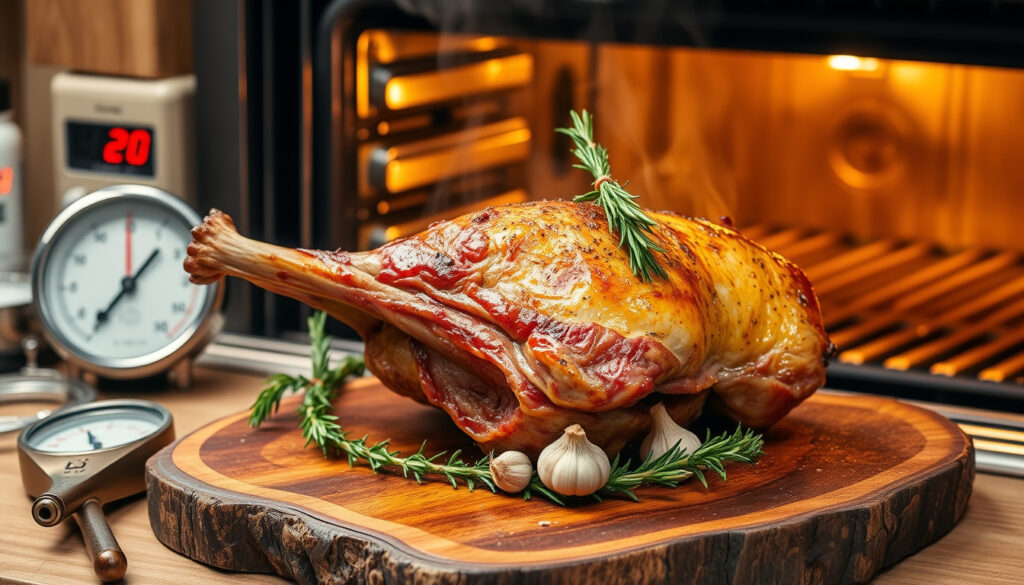
Leg of Lamb Cooking Time: Per Kg, Oven Temps & Tips
Few things are more disappointing than carving a beautiful-looking roast only to find it dry as sawdust in the middle. A leg of lamb cooks unevenly if you guess, but the major UK sources — Bromfield’s Butchers, The Mediterranean Dish, and Andy Cooks — all land on essentially the same formula. Get this right and you’ll be pulling a medium-perfect centre every time, no thermometer guesswork required.
Medium (bone-in): 50 min per kg + 25 min resting ·
Oven: 180°C / 160°C fan ·
Pull temp: 60-65°C (medium) ·
Bone-in adjustment: +10-15 min
Quick snapshot
- 1–1.5 kg bone-in: ~1 hr medium (The Mediterranean Dish)
- 2 kg bone-in: ~1 hr 20 min (Bromfield’s Butchers)
- 2.5 kg bone-in: ~1 hr 40 min (scaled from 50 min/kg) (The Mediterranean Dish)
- 3 kg bone-in: ~2 hrs (scaled from 50 min/kg) (The Mediterranean Dish)
- Rare: 50°C internal (Bromfield’s Butchers)
- Medium: 60–65°C (Bromfield’s Butchers)
- Well done: 70°C+ (Bromfield’s Butchers)
- Fall-off-bone: 80°C+ (Kevin is Cooking)
- Hot blast start: 220°C for 20 min, then drop (Bromfield’s Butchers)
- Slow roast covered: 150°C for 4 hours (Andy Cooks)
- Fan oven: reduce listed temps by 20°C (Bromfield’s Butchers)
- Skipping the thermometer — times are estimates (Bromfield’s Butchers)
- No resting = juice loss (NZ Spring Lamb)
- Overcooking past 70°C for medium (Bromfield’s Butchers)
The table below summarises the key cooking parameters used by UK and US authorities.
| Parameter | Value |
|---|---|
| Standard oven temp (conventional) | 180°C |
| Fan oven equivalent | 160°C |
| Medium per 500 g | 25 min + 25 min resting |
| Medium per kg | 50 min + 25 min |
| Rest time post-roast | 15–30 min |
| Bone-in adjustment | +10–15 min vs boneless |
| Ground lamb safety temp | 71°C / 160°F |
How long does a leg of lamb take to cook per kg?
The foundation for every lamb leg roast is the per-kilogram timing rule. According to Bromfield’s Butchers (UK butcher authority), the UK method works like this: start at 220°C for 20 minutes to develop a crust, then drop to 180°C for the remaining time. Rare takes 40 min/kg total, medium takes 50 min/kg, and well-done takes 60 min/kg.
Medium rare per kg
- Rare (50°C): 40 min/kg — pull when thermometer reads 50°C
- Medium-rare (55°C): 45 min/kg
- NZ Spring Lamb confirms medium-rare for 4–5 lb legs runs 1h 20m to 1h 40m at 350°F (175°C), targeting 130–135°F (54–57°C)
Medium per kg
- Medium (60–65°C): 50 min/kg — this is what most UK home cooks aim for
- Per The Mediterranean Dish: medium at 325°F (160°C) requires 25 min/lb (roughly 55 min/kg)
- American Lamb Board guidelines for 5–7 lb bone-in at 325°F: 25–30 min/lb for medium
Well done per kg
- Well done (70°C+): 60 min/kg or more
- The Mediterranean Dish: well done at 30 min/lb (67 min/kg) reaching 155–165°F (68–74°C)
Bone-in adjustments
- Bone-in legs take longer than boneless due to bone conduction slowing heat penetration
- Expect roughly 10–15 minutes additional cook time for bone-in vs. boneless of the same weight
- Kevin is Cooking notes that boneless legs for medium finish around 20 min/lb, while bone-in fall-off-bone needs 40 min/lb at 300°F (150°C)
“For a juicy medium with a pink center, pull it at 135°F to 140°F internally.” — Billy Parisi, chef
What temperature should legs of lamb be cooked at?
Oven temperature choice shapes everything from crust development to connective tissue breakdown. The major sources agree on a two-phase approach, but they split on whether to start hot or stay consistent throughout.
Oven starting blast
- Bromfield’s Butchers: 220°C for 20 minutes, then reduce to 180°C
- La Boite NY: 400°F (200°C) initial 15 minutes, then 350°F (175°C) for 60–90 min to reach 130°F medium-rare
- Billy Parisi: 425°F (220°C) for 25 minutes to sear the exterior, then reduce to 350°F (175°C) for 80–90 minutes
Roasting temp
- Standard UK roast: 180°C / 160°C fan
- American Lamb Board recommends 325°F (160°C) as the primary roast temperature
- Slow method: Andy Cooks seals the leg and roasts at 150°C (300°F) covered for 4 hours, then hits 200°C (400°F) for 20 minutes to crisp
Internal doneness temps
- Rare: 50–52°C internal (Bromfield’s Butchers) — carries over to 54–55°C during resting
- Medium: 58–60°C — carries over to 62–63°C
- Well: 65–70°C+
- Fall-off-bone: Kevin is Cooking specifies 175°F (80°C) internal or higher for falling apart texture
- ThermoWorks (thermometer manufacturer): for medium-rare, pull at 52°C; the carryover will land you at 60°C medium
“Cook to 125°F (52°C) using a leave-in thermometer.” — ThermoWorks, thermometer expert
High-heat starts (220°C+) create a crust but risk overcooking outer layers if you forget to drop the temp. Low-and-slow (150°C) renders connective tissue for pull-apart texture but won’t crisp the exterior without a finishing blast.
Should I cover a leg of lamb with foil when roasting?
Foil use splits the cooking world: it traps steam for moisture, but it also steams the skin instead of crisping it. The right answer depends entirely on your desired end result.
Foil for slow roast
- Andy Cooks seals the leg in foil at 150°C for 4 hours — the foil traps steam that breaks down collagen, resulting in butter-soft meat
- Billy Parisi covers bone-in leg in foil at 325°F (160°C) for 4–4.5 hours reaching 202–205°F (95–96°C) internal for fall-off-bone texture
- Kevin is Cooking: 4–4.5 lb bone-in covered 4.5 hours at 300°F (150°C), then uncovered 45 minutes to brown
Uncover for crisp
- The Mediterranean Dish leaves the leg uncovered at 325°F for the full cook to develop a golden, slightly crispy exterior
- Bromfield’s Butchers recommends removing foil for the final 20–30 minutes of roasting to colour the surface
Resting with foil
- All sources agree: tent the resting lamb loosely in foil for 20–30 minutes — this is not for crisping but for carryover cooking and juice redistribution
- NZ Spring Lamb: rest 15 minutes minimum; the temp will rise 5–10°F during this period
“This is one of the most forgiving dishes you can make in the oven.” — Andy Cooks, chef
The moment you tent foil over a roasting-hot leg, you’ve stopped the Maillard reaction (browning) and started retention cooking. Use foil during the cook for fall-off-bone, skip it for a rosy medium with a caramelised crust.
How long do you cook a 2kg lamb roast?
A 2 kg leg sits in the middle of the typical weight range and is where most home cooks need precise guidance. Here’s what the sources say for that specific weight.
2kg bone-in
- Medium: ~1 hr 40 min at 180°C / 160°C fan (Bromfield’s Butchers: 50 min/kg)
- Hot start method: 220°C for 20 min, then 180°C for ~80 min
- Medium-rare: ~1 hr 20 min at 180°C
- Well done: ~2 hrs at 180°C
2kg boneless
- Boneless cooks 10–15 minutes faster than bone-in at the same weight
- 2 kg boneless medium: approximately 1 hr 25 min at 180°C
- ThermoWorks notes that boneless legs cook faster because heat penetrates evenly without bone conduction slowing the process
2.5kg and 3kg scaling
- 2.5 kg bone-in medium: ~1 hr 40 min + 25 min rest
- 3 kg bone-in medium: ~2 hrs + 25 min rest
- American Lamb Board: for 5–7 lb legs (2.3–3.2 kg), allow 20–25 min/lb for medium-rare, 25–30 min/lb for medium
- NZ Spring Lamb: 6–7 lb legs (2.7–3.2 kg) medium runs 2h 10m to 2h 30m at 350°F
What are common mistakes when cooking lamb legs?
Even with a straightforward formula, a few recurring errors can derail an otherwise well-planned roast. Here’s what separates a dry, overcooked disappointment from a rosy, juicy centre.
Overcooking dryness
- The Mediterranean Dish: well-done temperatures (155–165°F / 68–74°C) produce dry, grey meat — medium at 135–140°F (57–60°C) is the sweet spot for juiciness
- The biggest risk is continuing past 65°C for medium — beyond this, muscle fibres contract and squeeze out moisture irreversibly
- Bromfield’s Butchers: ovens vary significantly — always trust the thermometer over the clock
Skipping the rest
- NZ Spring Lamb: rest a minimum 15 minutes, ideally 20–30; cutting immediately releases all the juices onto the board
- ThermoWorks: carryover cooking raises internal temp 5–10°F during rest — factor this in when pulling
- Tenting in foil during rest traps heat gently without creating steam that softens the crust
Wrong temp calibration
- Insert thermometer in the thickest part of the meat, avoiding contact with bone — bone reads artificially high
- Bromfield’s Butchers: calibrate your oven with an oven thermometer — home ovens can be off by 15–20°C
- Leave-in probes (like ThermoWorks recommends) let you monitor without opening the oven
A leg of lamb punishes guesswork and rewards precision. The formula — 50 min/kg for medium, pull at 60–65°C, rest 25 minutes — works consistently across UK and US sources. The one variable that changes everything: a reliable meat thermometer. Everything else is window dressing.
Upsides
- Very forgiving with high-heat start or low-slow covered method
- One formula (50 min/kg medium) works across UK/US sources
- Resting time lets you make jus, salad, or finish other dishes
- Versatile: works for family dinner or dinner party centrepiece
Downsides
- Requires a 4+ hour window for slow method
- Bone-in weights hard to judge exactly — always buy slightly larger
- UK/US units split means metric/imperial conversion errors common
- No thermometer = significant overcooking risk for medium-rare
Related reading: How Long to Boil Potatoes · 8 Stone in KG
For tailoring roast times to your exact weight, bone-in cut, and oven type, a leg of lamb cooking time calculator delivers precise adjustments beyond basic per-kg estimates.
Frequently asked questions
How long to cook a 2.5kg leg of lamb?
A 2.5 kg bone-in leg at medium requires approximately 1 hr 40 min at 180°C (160°C fan), plus 25–30 minutes resting. The formula scales directly: 50 min/kg for medium doneness.
What is bone-in leg of lamb cooking time?
Bone-in takes roughly 10–15 minutes longer than boneless at the same weight. Per American Lamb Board, bone-in 5–7 lb legs at 325°F need 20–25 min/lb for medium-rare, 25–30 min/lb for medium. This translates to 45–55 min/kg for bone-in medium.
What is boneless leg of lamb cooking time per kg?
Boneless leg of lamb at medium requires approximately 40–45 min/kg at 180°C, slightly faster than bone-in. Kevin is Cooking: boneless medium needs 20 min/lb (44 min/kg) at 300°F, compared to 40 min/lb for bone-in fall-off-bone.
How long to cook lamb legs in the oven at 180 degrees?
At 180°C (conventional oven): medium leg runs 50 min/kg. At 160°C (fan oven): same timing applies. For a 1.5 kg leg, that’s roughly 1 hr 15 min; for 2 kg, about 1 hr 40 min. Always add 25 minutes resting.
What’s the best way to cook a leg of lamb in the oven?
The most reliable method: high start at 220°C for 20 minutes, then reduce to 180°C and roast for 50 min/kg (medium). Use a meat thermometer to pull at 60–65°C internal, then rest tented in foil for 25 minutes. Andy Cooks offers an alternative: sealed slow roast at 150°C for 4 hours, then 200°C for 20 minutes to finish.
What temperature for internal doneness?
For lamb leg: rare 50°C, medium 60–65°C, well done 70°C+. Bromfield’s Butchers notes that carryover adds 3–5°C during resting. Pull 5°C below target to account for this. Ground lamb must reach 71°C (160°F) for safety, per NZ Spring Lamb.
How to cook a lamb roast?
Season generously, sear at high oven heat (220°C) for 20 minutes, then roast at 180°C for 50 min/kg for medium. Use a thermometer, pull at 60–65°C, rest 25 minutes tented in foil. The Mediterranean Dish recommends marinating 12–48 hours beforehand in garlic, rosemary, and wine for deeper flavour penetration.
For UK home cooks, the formula is settled: 50 min/kg at 180°C for medium, pull at 60–65°C, rest 25 minutes. The variables that move the needle are your oven’s true temperature, the accuracy of your thermometer, and whether you use foil during cooking. Get those three things right and a perfectly rosy, juicy leg of lamb becomes routine rather than luck.
More related posts
 Kia Optima for Sale: Best Years, Problems & Prices 2025
 Joshua vs Jake Paul: Anthony Joshua KO Win Round 6
 How to Get Rid of a Headache Fast: NHS Tips
 SEO Content Brief Template – Effektiv Struktur För Bättre Innehåll
 Staycity Aparthotels Dublin City Centre: Booking & Reviews
 Ireland Autumn Internationals 2025: Fixtures, Tickets, TV Channels & Venue
 National Concert Hall 2026 Events: Concerts, Dress Code & Guide
 Best Arroz con Leche Boliviano Near Me: Local’s Guide